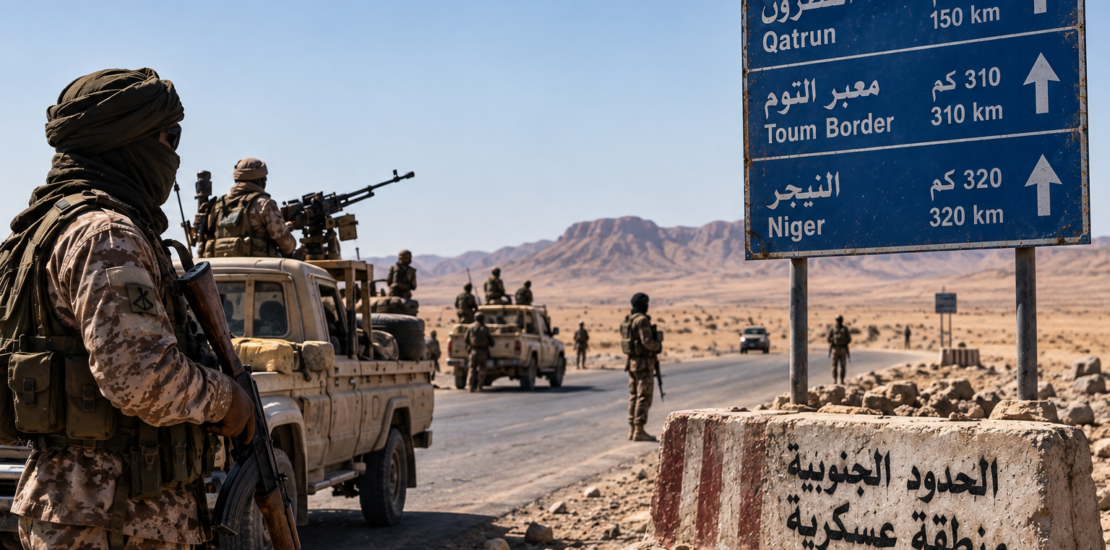
Fezzan on the Frontline: The Struggle over Routes and Borders Reshapes Southern Libya’s Security Landscape

The announcement by a group calling itself the “Fezzan Revolutionary Force” that it was closing Libya’s southern borders to trucks and commercial traffic has drawn renewed attention to an emerging security shift in the country’s far south, where armed activity against forces affiliated with eastern Libya’s military command has increased across the vast desert region bordering Niger, Chad, and Sudan.

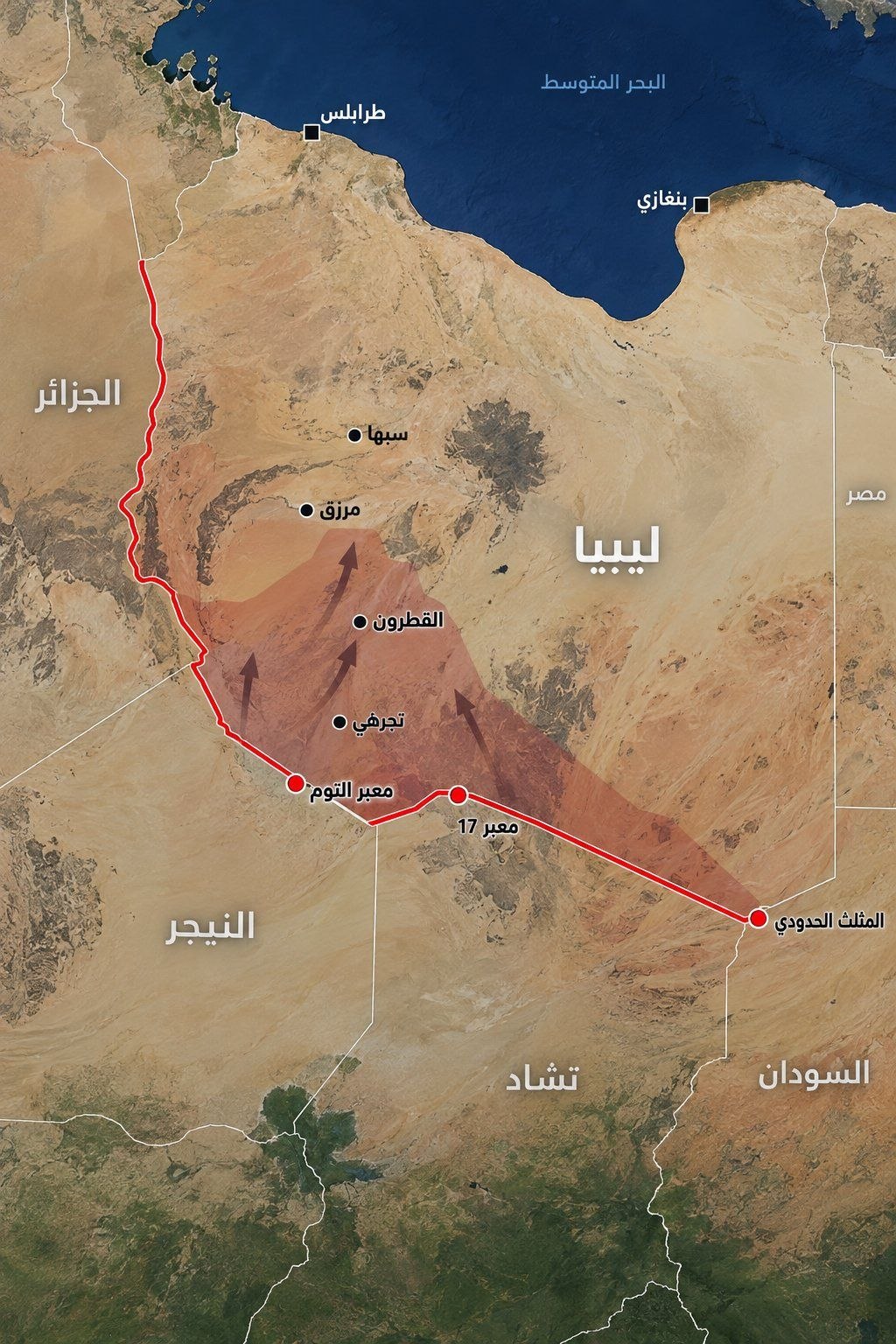
On September 12, the group declared the belt stretching from the Algerian border in the west to the tri-border area with Chad and Sudan in the east a “closed military zone.” It linked the decision to what it described as a siege imposed on the town of Qatrun and restrictions on deliveries of fuel and cooking gas. The group also threatened to target trucks it accused of smuggling Libyan fuel into neighboring countries. There is currently no independent evidence demonstrating that the group can enforce such a closure across the entire border zone identified in its statement.

The announcement represents the latest development in a series of tensions that have affected southern Libya throughout 2026, particularly around Qatrun and the areas extending toward the Toum border crossing and the frontiers with Niger and Chad. Armed groups operating in this environment have largely relied on mobility across the desert and attacks on military positions and transportation routes rather than sustained control of major towns.

Qatrun: The Trigger for the Latest Escalation

Qatrun lies in Libya’s far southwest, within the Murzuq region, and serves as an important point along routes leading south toward Niger and Chad.

The latest escalation began on September 3, 2026, when a young Tebu man, Hussein Youssef Ibrahim, was killed in a shooting incident at a fuel station. The incident was followed by an attack by local gunmen against the headquarters of a military unit affiliated with eastern Libyan forces. The town subsequently witnessed raids and arrests.

On September 9 and 10, local reports indicated that approximately 23 Tebu individuals were detained, including people suspected of involvement in the attack as well as local social and security figures. These developments further increased tensions in and around Qatrun.

On September 9, the Southern Liberation Operations Room (SLOR) issued a statement condemning developments in Qatrun and calling on residents of Fezzan to confront Haftar’s forces. Three days later, the Fezzan Revolutionary Force announced the closure of the southern border, transforming what had begun as a localized crisis in Qatrun into a direct threat against border routes and crossings.
The Fezzan Revolutionary Force and the Southern Liberation Operations Room

The Fezzan Revolutionary Force emerged during 2026 within the increasingly unstable military environment of southern Libya, alongside the activities of the Southern Liberation Operations Room, an armed formation led by Mohammed Wardougou and including fighters from the Tebu community.

The two groups overlap geographically, share a common military adversary, and employ similar rhetoric concerning political and economic conditions in Fezzan. Several reports have linked them. However, the organizational relationship between the Fezzan Revolutionary Force and SLOR has not been publicly established with sufficient clarity to conclude that they constitute a single organization.

SLOR announced in April 2026 that it was launching military operations against positions belonging to eastern Libyan forces in the south. During the following months, it appeared in a series of attacks and clashes involving military checkpoints, desert routes, and border areas.

Mohammed Wardougou: From the Eastern Military Network to Armed Confrontation

Mohammed Wardougou is one of the most prominent figures associated with the military escalation in Fezzan.

A member of the Tebu community, Wardougou previously operated within armed formations associated with the eastern Libyan military network before eventually turning against it.

During 2026, he emerged as the commander of the Southern Liberation Operations Room, which publicly declared eastern military positions in Fezzan as targets.

Recent assessments place Wardougou and forces associated with him within the wider desert environment connecting southern Libya and northern Niger. This vast borderland provides armed groups with considerable room to maneuver, withdraw, and reposition away from major population centers.

This geography gives mobile desert forces an advantage fundamentally different from conventional territorial control. Fighters can attack a checkpoint, military installation, or transport route and withdraw across considerable distances before reinforcements arrive.

From the Toum Crossing to the Chadian Border

The area extending south from Qatrun toward the Toum crossing on the Libyan-Nigerien border has become one of the principal theaters of confrontation during 2026.

Earlier in the year, forces associated with the Southern Liberation Operations Room reached the Toum crossing and temporarily seized it before eastern Libyan forces re-established their presence in the area.

Subsequent attacks and clashes were reported at several locations across Fezzan, including military positions and routes leading toward Niger and Chad.

These operations do not demonstrate coherent territorial control by forces opposing eastern Libya’s military command. They do, however, demonstrate an ability to conduct attacks across a wide geographic area and force the dominant military actor in the south to protect an expanding network of roads, bases, checkpoints, and border crossings.

A War for the Roads

The emerging conflict in Fezzan differs considerably from the battles that have taken place in Libya’s northern cities during previous phases of the conflict.

Holding a major city requires significant manpower, supply lines, heavy equipment, and the ability to defend territory. Desert warfare allows considerably smaller forces to rely on armed vehicles and move between roads and sparsely populated areas.

As a result, roads, border crossings, and supply convoys have become central to the confrontation.

An armed group does not need to control hundreds of kilometers of border territory to disrupt movement across it. The ability to attack a convoy, strike a checkpoint, or intercept commercial trucks may be enough to increase transportation risks and force the dominant military force to allocate additional resources to protecting routes.

From this perspective, the map published by the Fezzan Revolutionary Force represents an area in which the group has declared its intention to operate militarily rather than evidence of actual territorial control.

Fuel as an Instrument of Conflict

Fuel lies at the center of the latest confrontation.

The Fezzan Revolutionary Force linked its border closure to alleged restrictions on fuel and cooking gas deliveries to Qatrun, while simultaneously accusing networks operating in the region of using trucks to smuggle subsidized Libyan fuel into neighboring countries.

These allegations originate from the group itself, and all their details have not been independently verified.

Nevertheless, the dispute reflects a broader problem in southern Libya, where fuel supply routes form part of a border economy extending toward Niger and Chad.

Control over these routes gives local actors the ability to influence the supply of fuel and other commodities to remote communities while also affecting commercial activity across national borders.

In Fezzan, the question of who controls the road can therefore become as important as who formally controls the surrounding territory.

The Tebu and Local Divisions

Tebu fighters constitute an important component of the social environment surrounding some of the armed groups opposing eastern Libyan forces in the region, but the Tebu should not be understood as a unified political or military actor.

Tebu communities extend across southern Libya, northern Chad, and Niger, and their different factions and leaders have entered varying alliances over the years, including cooperation with eastern Libyan forces.

The current confrontation therefore cannot accurately be reduced to a conflict between “the Tebu” and Haftar’s forces. It is instead a confrontation involving armed formations and local leaders, some of whom are Tebu, amid broader divisions over alliances, resources, and the political and military order in southern Libya.

The Desert Connecting Libya to the Sahel

Fezzan’s strategic importance derives largely from its geography.

Southern Libya connects with Algeria to the west, Niger and Chad to the south, and Sudan to the east. Across this enormous space lies a network of desert routes used for legitimate trade and population movement, alongside networks involved in the trafficking of fuel, weapons, and people.

Security assessments published in September indicate that the region connecting northern Niger, southern Libya, and northwestern Chad provides operating space for several armed and rebel groups that benefit from the enormous distances involved and the difficulty state authorities face in monitoring every desert route.

Prolonged instability in Fezzan could therefore have consequences beyond Libya, particularly if control over key crossings changes or armed groups increase their cross-border movements.

The Niger Dimension

The Nigerien dimension has become increasingly significant during September.

On September 17, Africa Intelligence reported on contacts and activities involving Tripoli and Niamey related to the border region and the confrontation with Haftar’s forces, linking these developments to the armed group led by Mohammed Wardougou.

Details concerning potential external logistical support require additional independent corroboration before they can be treated as established facts.

Northern Niger nevertheless represents a significant geographical extension of the security environment in southern Libya. The long border and vast desert spaces create an operating environment that is extremely difficult to control comprehensively.

This increases the importance of monitoring the relationship between developments in Fezzan and events in northern Niger and Chad, where armed organizations and economic and security networks operate across national borders.

What Can the Fezzan Revolutionary Force Actually Do?

There is currently no evidence demonstrating that the Fezzan Revolutionary Force possesses the manpower and military capabilities required to control the entire region it has declared closed.

A zone stretching from Algeria to Sudan encompasses an enormous expanse of desert that would require considerably greater forces and logistical resources to control permanently than those publicly demonstrated by the group.

Full territorial control, however, is not necessary to disrupt movement.

A mobile armed force capable of operating in the desert and striking selected targets may be able to render individual routes unsafe for limited periods. This would require eastern Libyan forces to expand their deployment and protect a larger number of convoys, crossings, bases, and checkpoints.

The confrontation therefore becomes a struggle over freedom of movement as much as a struggle over territorial control.

Syria Monitor Assessment

Developments through September 18, 2026 do not indicate a comprehensive shift in the military balance of power in southern Libya. Eastern Libyan forces continue to possess a broader military presence and greater resources than those publicly demonstrated by the armed formations opposing them.

Events during 2026 have nevertheless shown that controlling Fezzan’s main population centers does not necessarily translate into comprehensive control of the surrounding desert.

Attacks on border crossings and military positions, tensions in Qatrun, and the emergence of armed groups capable of moving across border regions are creating a pattern closer to mobile attrition than conventional warfare for permanent control of cities.

The vast desert environment allows armed groups to strike, withdraw, and reposition, while the dominant military force must protect an extensive network of roads, military installations, and border crossings.

The size of these groups, their financing and weapons supplies, and the extent of their external relationships remain among the principal uncertainties surrounding the conflict. The organizational relationship between the Fezzan Revolutionary Force and the Southern Liberation Operations Room also remains unclear.

Continued confrontation, however, is likely to increase the strategic importance of the routes connecting southern Libya with Niger and Chad.

Conclusion

The Fezzan Revolutionary Force’s declaration does not mean that Libya’s southern border has fallen under the group’s control. It does, however, reveal a shift in the nature of the security challenge facing forces deployed across the south.

The issue is no longer simply who controls Sabha, Murzuq, or Qatrun, but who can keep the roads connecting these areas to the borders open and secure.

Fezzan sits at the intersection of Libya and a wider security space extending into Niger, Chad, and Sudan. Trade, fuel, weapons, and people move through a complex network of official highways and informal desert routes across this region.

In this geography, an armed group does not necessarily need to control territory to alter the balance of power.


Leave a Reply