ISIS in August 2026: Rising Attacks in Syria and Sustained Operational Pressure in Africa and Iraq
-
August 29, 2026
- Posted by: Syria Monitor
- Categories: Africa, Iraq, SITUATION ASSESSMENT, Special Reports, Syria, Timelines, Uncategorized
Monthly Monitoring Report on ISIS Activity and Potentially ISIS-Linked Attacks – August 2026
Syria Monitor – Strategic Research Center
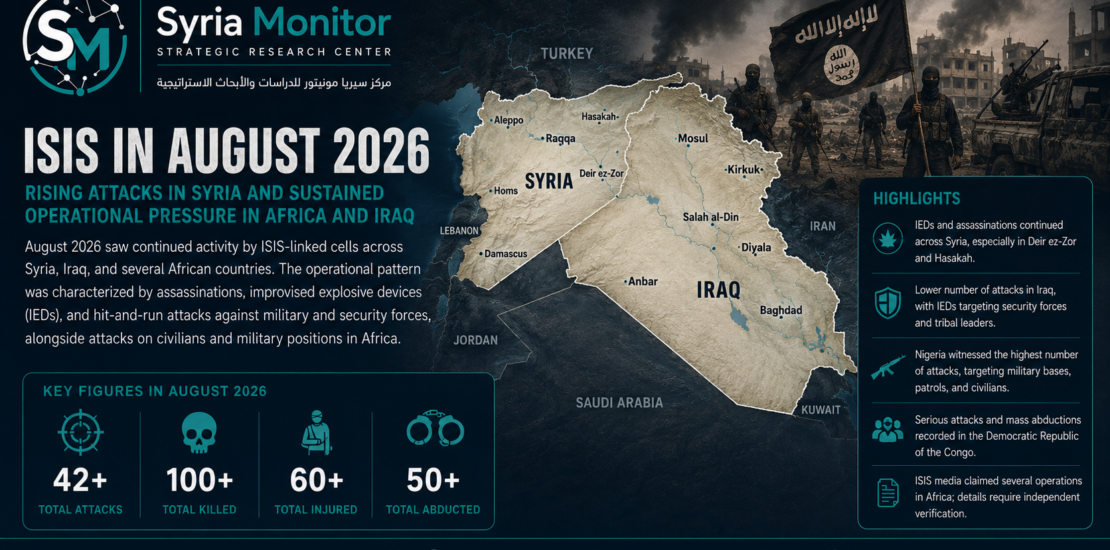
August 2026 saw continued activity by armed cells across Syria, Iraq, and several African countries. The operational pattern was characterized by assassinations, improvised explosive devices (IEDs), and hit-and-run attacks against military and security forces, alongside attacks on civilians and military positions in Africa.
This report is based on incidents monitored by the Syria Monitor – Strategic Research Center throughout the month. It is important to distinguish between attacks officially claimed by ISIS, incidents attributed to the group by security, local, or credible media sources, and incidents that remain suspected of ISIS involvement based on the target, modus operandi, or geographic location. Therefore, inclusion in this monitoring report does not necessarily constitute confirmation of ISIS responsibility.
Syria
Syria witnessed geographically dispersed security incidents during August, with a noticeable concentration in Deir ez-Zor and Hasakah, alongside incidents in Daraa, Rural Damascus, Raqqa, Aleppo, and Palmyra. IEDs, assassinations, and shootings were among the principal methods observed.
On August 2, an IED targeted the vehicle of a Syrian Ministry of Defense member in Nimr, northern Daraa countryside, wounding him and damaging the vehicle. On the same day, gunmen shot and killed a person in Ghwayran neighborhood in Hasakah city.
On August 6, the body of a military member who had been shot in the head was found in al-Hadriyat village near Ain Issa, northern Raqqa.
On August 8, gunmen attacked a former National Defense Forces member in al-Qusour neighborhood of Deir ez-Zor city, seriously wounding him. On the same day, a grenade attack targeted a General Security patrol on al-Darwish Street in al-Quriyah, eastern Deir ez-Zor, with no confirmed casualty figures available.
On August 18, an IED targeted the al-Shaddadi gas pipeline near Ain al-Malha in southern Hasakah countryside, highlighting the continued vulnerability of critical infrastructure to sabotage and armed attacks.
Also on August 18, gunmen assassinated a member of the General Security’s Studies Department near Badr al-Din Aifan School in al-Jubaylah neighborhood of Deir ez-Zor city. A General Security patrol was also attacked by gunmen in al-Zir village, eastern Deir ez-Zor, with no confirmed casualty figures available.
On August 22, an IED targeted a bus transporting General Security personnel on the Maarouna–al-Tall road in Rural Damascus, causing injuries according to preliminary reports. On the same day, gunmen attacked a Border Guard position in the Al-Bukamal area of eastern Syria.
On August 24, an unidentified explosion in Palmyra killed one person and wounded several others. As the nature of the explosion and the party responsible remained unclear, the incident is included for monitoring purposes without attribution to ISIS. On the same day, gunmen using automatic weapons killed a person in the al-Maghla area of Raqqa.
On August 25, the decapitated body of Abdul Rahman al-Jaad, a member of a religious fatwa committee affiliated with the former Syrian regime, was found along the Suran–Talalin road in Aleppo province. According to preliminary information, four individuals had taken him from his home under the pretext of attending a marriage-contract ceremony before killing and decapitating him.
On August 26, gunmen attacked a military nurse and an army member on the Aleppo highway near the Ghosajli junction, wounding one in the shoulder and leaving the other seriously injured. On the same day, the body of a person who had been shot in the head was found in al-Shamsani village in southern Hasakah countryside.
On August 28, an IED exploded outside the Justice Palace in Hasakah city, killing two people according to an initial casualty count.
Assessment of Activity in Syria
August monitoring shows a broad geographic distribution of incidents, but Deir ez-Zor and Hasakah remained the most sensitive areas in terms of repeated attacks, assassinations, and IED incidents. This indicates the continued ability of armed cells to operate within a changing security environment, particularly in eastern Syria and areas connected to movement corridors toward the Syrian Badia and the Iraqi border.
At the same time, incidents in Rural Damascus, Aleppo, Daraa, Raqqa, and Palmyra do not necessarily indicate an organizational presence comparable to that in eastern Syria. Responsibility for several incidents had not been claimed or independently established by the time this report was prepared, preventing their direct attribution to ISIS without additional evidence.
Iraq
The number of incidents monitored in Iraq during August was lower than in Syria and Africa. Nevertheless, IED activity remained a notable indicator, particularly in areas with a longstanding history of ISIS cell activity.
On August 2, large fires affected agricultural land in Rabia, west of Mosul, alongside other fires in areas extending toward Duhok. On the same day, Shwan Khalis was shot dead inside his vehicle near Aviation Square in Kirkuk by gunmen riding a motorcycle.
On August 3, fires continued to affect agricultural areas around Rabia, west of Mosul. On August 5, another fire was recorded in an orchard in Khalis district, Diyala province, while a large fire was reported in Yayji, Kirkuk, on August 6. There was insufficient evidence to classify these fires as ISIS operations, and Syria Monitor therefore retains them as monitored incidents rather than confirmed ISIS attacks.
On August 8, preliminary reports indicated an IED explosion north of Muqdadiyah in Diyala, although the target and casualty figures remained unclear.
On August 11, an IED targeted an Iraqi Army force in Wadi al-Shay, Kirkuk province, as it moved to inspect a location that had previously been targeted by an airstrike. Three military personnel, including an officer, were wounded. The incident demonstrates the continued utility of IEDs for targeting security forces operating in areas of militant activity.
On the same day, an IED explosion near Dujail in Salah al-Din province killed two people, according to preliminary information.
On August 26, an IED targeted the vehicle of Mandoul al-Jughaifi, a leader in the Jughaifa tribal mobilization forces, in the Anbar desert, causing extensive damage to the vehicle. No confirmed casualties were reported.
Overall, Iraq experienced a relatively lower operational tempo during August. However, continued IED incidents across Kirkuk, Diyala, Salah al-Din, and Anbar demonstrate that rural and desert environments continue to provide space for small cells capable of conducting limited, low-cost attacks.
Africa
Africa continued to record the highest intensity of militant activity within Syria Monitor’s geographic scope during August, particularly in Nigeria, the Democratic Republic of the Congo, Niger, Cameroon, and Somalia. Attacks included assaults on military bases and patrols, as well as large-scale violence against civilians and kidnapping operations.
On August 2, an IED explosion in Wadi Ja’il, Puntland, northeastern Somalia, killed ten members of the Puntland forces. On the same day, gunmen assassinated a Puntland forces officer outside his home in Galkayo. A communications tower in the Cal Miskaad Mountains was also destroyed, and a force subsequently dispatched toward the site to restore communications was reportedly ambushed, with preliminary reports indicating significant casualties.
On August 5, Syria Monitor recorded several statements issued by ISIS media claiming operations in Nigeria and the Democratic Republic of the Congo, including attacks against Nigerian military forces in Borno and incidents targeting individuals in Ituri. Syria Monitor treats these statements as claims by the organization unless their details are independently corroborated.
On August 10, gunmen attacked a Nigerian Army base in Gajiram, Borno State, with reports indicating that the position was overrun and troops withdrew. On the same day, an armed attack in Kebbi State, western Nigeria, reportedly killed ten soldiers.
On August 11, gunmen burned a military intelligence office in Beni, Democratic Republic of the Congo, after personnel fled the facility.
On August 12, four soldiers were killed in an armed attack in northeastern Nigeria.
On August 15, at least ten civilians were killed in an armed attack in the Ogonshi area of Sokoto State, northwestern Nigeria. On the same day, a military base in Seguidine, Agadez Region, Niger, came under a violent dawn attack, with preliminary reports indicating that the base was burned. Final casualty figures were not available.
Also on August 15, gunmen attacked a Nigerian Army Forward Operating Position (FOP) in the Mandaragirau area of Borno State. Nigerian forces reportedly used rocket launchers in an attempt to repel the assault.
On August 16, an armed attack in Bandisende, Mambasa territory, Democratic Republic of the Congo, killed five people according to preliminary information. Approximately 50 others were abducted and taken to an unknown location.
On August 19, two IEDs targeted Nigerian Army forces on the Maiduguri–Dikwa and Marte routes in Borno State, with no final casualty figures available.
During the same period, Syria Monitor recorded an armed attack in Nigeria attributed in initial reporting to Fulani gunmen, reportedly resulting in the deaths of approximately 30 personnel. Syria Monitor does not automatically classify this incident as ISIS-related, nor does it consider ethnic or tribal affiliation evidence of organizational membership without independent indicators establishing such a connection.
On August 23, more than 25 bodies reportedly belonging to Christian civilians were discovered in Ituri, Democratic Republic of the Congo, following reports that armed men had killed them after they refused to submit to demands imposed by the attackers. The circumstances and direct responsibility for the killings require further corroboration.
On August 25, gunmen attacked three people in Gaboa, Mayo-Tsanaga, northwestern Cameroon, killing one and wounding two others.
On August 26, an IED targeting an individual in Zamfara State, western Nigeria, killed the victim.
Assessment of Activity in Africa
The incidents monitored during August reinforce Africa’s growing importance within the operational landscape of jihadist organizations. However, the security environment varies substantially between countries, and not every attack recorded in these areas can be attributed to ISIS.
In northeastern Nigeria, particularly Borno State, attacks on military bases, roads, and patrols, together with the use of IEDs, indicate a significantly higher operational tempo than in most other areas covered by this report. In eastern Democratic Republic of the Congo, attacks against civilians, kidnappings, and arson remained prominent, while developments in Somalia demonstrated the continued ability of armed groups to target security forces, communications infrastructure, and supply routes.
Key Trends in August
Analysis of the monitored incidents highlights three principal operational patterns.
The first is the continued use of improvised explosive devices, recorded in Syria, Iraq, Nigeria, and Somalia. IEDs were employed against patrols, military vehicles, fixed targets, and infrastructure.
The second is the persistence of assassinations and rapid hit-and-run attacks, particularly in Syria, where small cells can conduct limited operations without holding territory or maintaining a large visible presence.
The third is the occurrence of larger-scale attacks against military positions and civilian communities in Africa, reflecting a different operational environment from that observed in Syria and Iraq.
A clear distinction therefore exists between the three main theaters. In Syria, the primary concern is the ability of clandestine cells to remain concealed, move between areas, and conduct assassinations and bombings. In Iraq, activity remains at a lower level and relies more heavily on IEDs and rural or desert terrain. In parts of Africa, militant groups retain greater capacity to conduct direct assaults against military positions and civilian settlements.
Overall Assessment
The August 2026 data indicate that ISIS and its affiliated branches do not operate with a uniform level of capability across their different theaters.
In Syria and Iraq, the organization largely relies on small cells, IEDs, assassinations, and the exploitation of security gaps and remote rural or desert terrain. Some African branches, by contrast, operate in environments that allow larger and more direct attacks.
In Syria specifically, eastern Syria remains the primary area of concern, given the recurring incidents in Deir ez-Zor and Hasakah and the region’s proximity to the Syrian Badia, the Iraqi border, and transportation corridors connecting large areas of eastern and central Syria. However, the available evidence does not indicate a return to the territorial-control model previously employed by ISIS. Instead, the current pattern remains centered on decentralized cells and limited operations.
In Iraq, the lower number of attacks does not necessarily mean that cells have lost their ability to operate, particularly across areas connecting Kirkuk, Salah al-Din, Diyala, and Anbar. Activity there remains closer to a strategy of limited attrition than an attempt to seize or hold towns and territory.
Africa, meanwhile, continues to represent the most active theater within the current monitoring dataset, both in terms of attack frequency and the scale of some operations. Nigeria and the Democratic Republic of the Congo stand out particularly within this trend.
Conclusion
Syria Monitor’s August 2026 monitoring indicates that the threat posed by ISIS is increasingly defined not by its ability to hold territory, but by its capacity to adapt to local environments, preserve small operational cells, conduct low-cost attacks, and exploit security vacuums.
The organization’s strength should therefore not be assessed solely through the number of attacks. Other indicators—including target selection, persistence of activity within specific geographic areas, the ability to resume operations following security campaigns, movement corridors, recruitment, and financing—remain essential to evaluating its actual capabilities.
Syria Monitor – Strategic Research Center will continue monitoring ISIS activity across Syria, Iraq, and Africa, updating its database through field information and open-source reporting while maintaining a clear distinction between confirmed attacks, claims issued by ISIS media, and incidents for which responsibility remains undetermined.