Reviving the Kirkuk–Baniyas Pipeline: An Oil Corridor Reshaping Regional Energy and Power Dynamics
- July 18, 2026
- Posted by: Syria Monitor
- Categories: Economy & Illicit Networks, Geopolitics, RESEARCH
No Comments
Kirkuk–Baniyas at the Heart of the Struggle over Energy Corridors: Could the Syrian Coast Become an Alternative Gateway to the Strait of Hormuz?
Prepared by: Eyas Almohammad – Researcher and Director of Syria Monitor
Does the revival of the Kirkuk–Baniyas pipeline constitute an economic project between Iraq and Syria, or is it part of a broader US strategy to reshape oil export routes and reduce Iran’s ability to use the Strait of Hormuz as a means of pressure?
The project to revive the Kirkuk–Baniyas oil pipeline has returned to the forefront of the regional agenda following the signing of two memoranda of understanding by Syria and Iraq to rehabilitate and reactivate the pipeline, with the participation of a consortium of international companies and declared support from the United States. This development comes at a highly sensitive moment, amid growing threats to oil exports through the Strait of Hormuz and Iraq’s efforts to diversify its export outlets and reduce its reliance on maritime routes located within Iran’s sphere of influence.
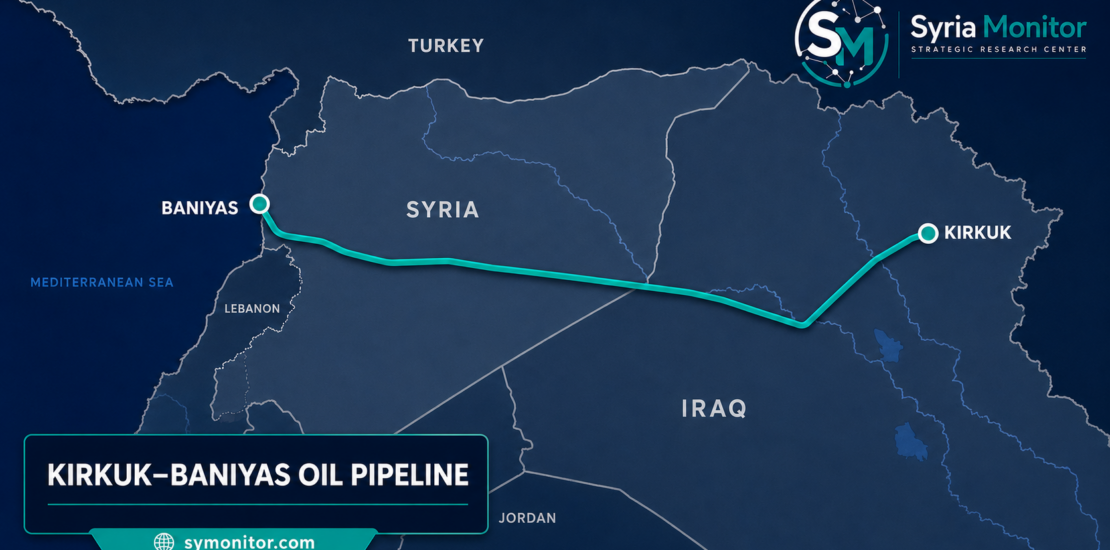
The pipeline extends from the oil fields of Kirkuk in northern Iraq, across Syrian territory, to the Mediterranean port of Baniyas. For decades, it served as one of Iraq’s most important oil export routes to European markets before becoming almost entirely inoperative after 2003 due to damage sustained by its infrastructure and pumping stations, as well as the political and security tensions experienced by both countries.
The significance of reviving the pipeline is not limited to restoring an old oil corridor. It also lies in its potential to reshape the region’s energy export network. For Iraq, the project would provide direct access to the Mediterranean, reduce heavy reliance on southern ports and the Strait of Hormuz, and give Baghdad greater flexibility in responding to regional crises and disruptions to maritime shipping routes.
For Syria, the project could offer an opportunity to restore its role as a regional energy transit corridor and generate revenue through transit fees, storage, and logistical services. It could also attract much-needed investment into the country’s oil infrastructure and revitalise the port of Baniyas and its associated facilities.
US support for the project reveals strategic dimensions that extend beyond the economic interests of Iraq and Syria. Washington views the pipeline as part of broader efforts to establish alternative export routes for the region’s oil and reduce Iran’s ability to use the Strait of Hormuz as leverage against the United States and its allies. The project could also pave the way for American and international companies to enter the energy and transportation sectors in Iraq and Syria.
At the same time, the project faces significant challenges related to the extent of damage sustained by the old pipeline, the cost of its rehabilitation, financing arrangements, the targeted transport capacity, and the nature of the commercial agreements among the participating parties. The proposed route also passes through a complex security environment encompassing areas that have witnessed activity by ISIS cells and the presence of armed factions. In addition, the pipeline and its pumping stations could face sabotage, extortion, or direct attacks should the regional confrontation escalate.
First: The Historical Background of the Kirkuk–Baniyas Pipeline
The Kirkuk–Baniyas pipeline is one of the oldest cross-border oil transportation projects in the Middle East. Its construction was linked to the expansion of Iraqi oil-field development and the search for export outlets capable of delivering crude oil to European markets through the Mediterranean.
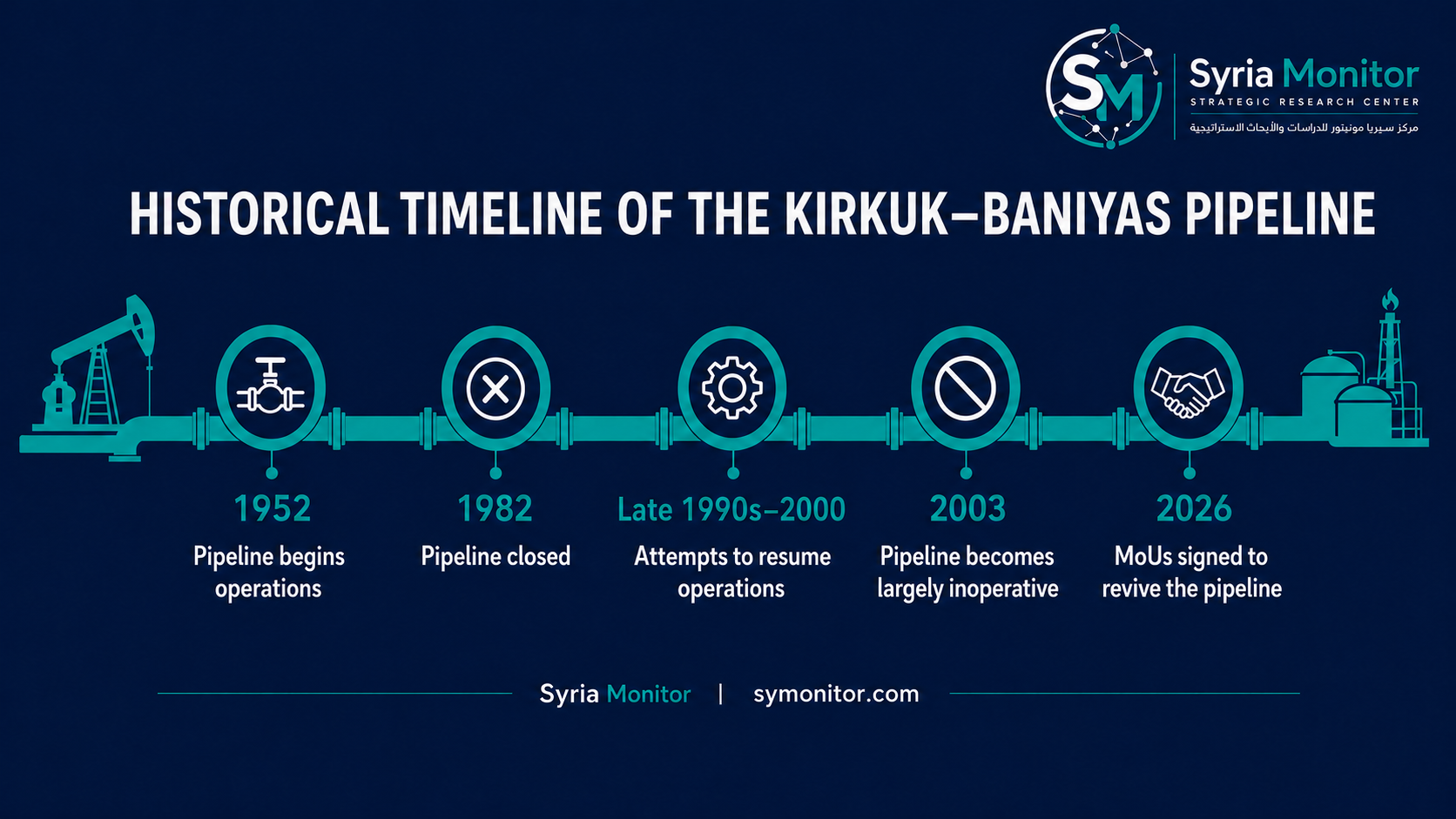
The pipeline began operations in 1952, connecting the Kirkuk oil fields in northern Iraq with the port of Baniyas on the Syrian coast. Its route extended for approximately 800 kilometres across Iraqi and Syrian territory, with an estimated transport capacity of around 300,000 barrels per day. At various points in its history, this made it one of Iraq’s principal oil export routes outside the ports of the Arabian Gulf.
When it was established, the pipeline marked a significant shift in the regional energy landscape. It gave Iraq direct access to the Mediterranean and shortened the distance required to transport oil to Europe. It also granted Syria an important position within the region’s energy transportation network by hosting most of the pipeline’s route, several pumping and storage stations, and facilities connected to the port of Baniyas.
The pipeline’s operation was never isolated from political relations between Baghdad and Damascus. During subsequent decades, it was affected by disputes between the two governments and experienced several periods of closure or reduced pumping rates. This demonstrated from an early stage that its continued operation depended not only on its technical condition but also on the level of political and security coordination between the two countries.
Following the outbreak of the Iran–Iraq War in 1980 and the mounting pressure on Iraq’s oil export routes, export outlets through Syrian and Turkish territory assumed greater strategic importance. However, the deterioration of relations between Baghdad and Damascus, coupled with Syria’s support for Iran during the war, led to the pipeline’s closure in 1982, depriving Iraq of one of its most important western outlets to the Mediterranean.
The pipeline remained out of service for many years before attempts to reactivate it resumed in the late 1990s and early 2000s, amid a period of rapprochement in Syrian–Iraqi relations. Reports indicate that it was used to transport limited quantities of Iraqi oil to Syria while Iraq was under international sanctions. However, this operation did not result in the comprehensive rehabilitation of the infrastructure or the restoration of the pipeline’s original capacity.
Following the US-led invasion of Iraq in 2003, the pipeline became almost entirely inoperative because of damage to parts of its infrastructure and pumping stations, the collapse of its operation and maintenance system, and growing security risks on both sides of the border. Since then, several projects have been proposed either to rehabilitate the pipeline or construct a new one alongside its original route, but none progressed to the implementation stage.
The Syrian war after 2011 further complicated the prospects of reviving the project. Large areas along the route became arenas of conflict and overlapping influence, while energy and transportation infrastructure suffered extensive damage. The emergence of ISIS and its seizure of territory in eastern Syria and western Iraq also turned the protection of any cross-border oil corridor into a security challenge extending well beyond technical repairs.
Despite its prolonged suspension, the Kirkuk–Baniyas pipeline remained part of Iraqi plans to diversify the country’s oil export outlets. Its continued importance stemmed from its geographical location and the possibility of directly connecting the oil fields of northern Iraq to the Syrian coast, rather than relying almost entirely on southern ports or routes through Turkish territory.
As Syria and the wider region underwent political and security transformations in recent years, the project gradually returned to official discussions. Joint technical committees were formed to assess the pipeline’s condition and examine rehabilitation options. These discussions subsequently developed into memoranda of understanding between Syria, Iraq, and a consortium of international companies to revive the project.
The nature of the current discussions indicates that the options under consideration are not limited to repairing the old pipeline, which has sustained extensive damage and exceeded its expected operational lifespan by several decades. They also include the possible construction of a new pipeline with greater transport capacity. This reflects the project’s evolution from an attempt to reactivate ageing infrastructure into a broader vision for establishing a new strategic corridor carrying Iraqi oil to the Mediterranean.
Second: Why Has the Pipeline Project Returned at This Particular Moment?
The revival of the Kirkuk–Baniyas project cannot be separated from the transformations affecting energy markets and the security environment in the Middle East. After remaining inoperative for more than two decades, the project returned to official discussions at a time when Iraqi oil exports face growing risks amid the escalating confrontation between the United States and Iran and disruptions to maritime traffic through the Strait of Hormuz.
Most Iraqi oil exports currently pass through the country’s southern ports on the Arabian Gulf, particularly the ports of Basra. This concentration leaves the Iraqi economy exposed to the consequences of any closure of the strait or attacks on maritime facilities and shipping routes, given the state budget’s heavy dependence on oil export revenues.
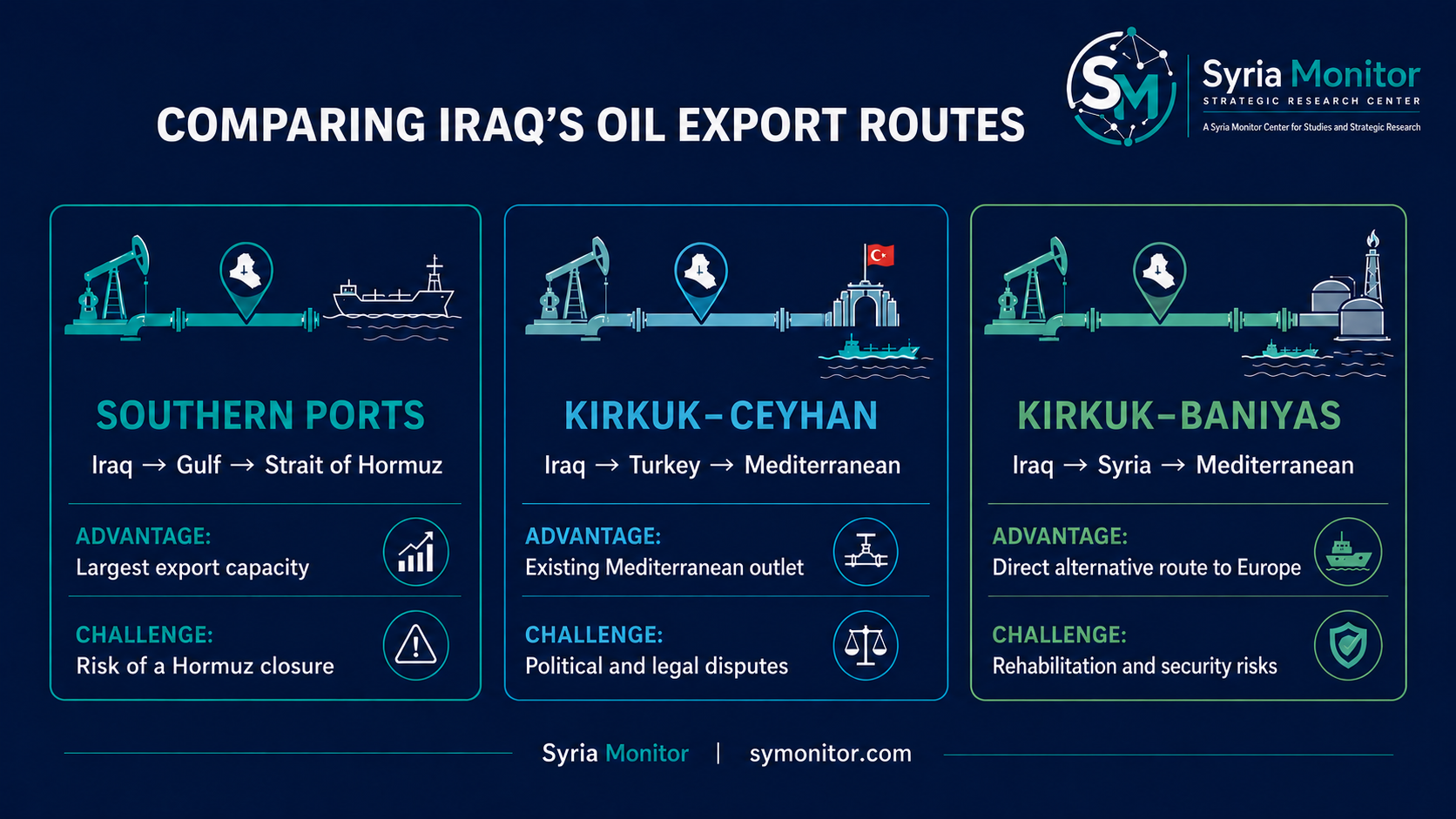
Recent regional confrontations have demonstrated that possessing substantial oil reserves is not sufficient to guarantee uninterrupted exports unless a country has multiple routes capable of delivering its crude to international markets. This has renewed the search for alternative overland outlets that bypass the Strait of Hormuz, foremost among them the Kirkuk–Ceyhan pipeline through Turkey and the Kirkuk–Baniyas pipeline through Syria, alongside other proposals to connect Iraqi oil fields to ports outside the Gulf.
Diversifying Iraq’s Oil Export Outlets
Diversifying export routes is one of Iraq’s primary motivations for reviving the pipeline. Repeated crises have shown that dependence on a single principal route leaves the country’s exports vulnerable to military tensions, political decisions, and maritime conditions in the Gulf.
Access to the port of Baniyas would provide Iraq with a direct western outlet to the Mediterranean and allow part of its production to reach European markets without passing through the Strait of Hormuz. It could also give Baghdad greater capacity to distribute exports among the southern ports and the Turkish and Syrian routes, thereby reducing losses if one of these outlets becomes inoperative.
This option assumes greater importance in light of Iraq’s plans to develop the Kirkuk oil fields and increase their production. Any potential increase will require transportation infrastructure capable of handling additional volumes. The Syrian route would connect northern Iraq’s oil fields to a relatively nearby seaport rather than transporting the entire output over longer distances towards the south.
War and the Security of Energy Corridors
The US–Iran war has once again demonstrated the importance of overland pipelines as instruments of national security rather than merely economic infrastructure. Iran has used its ability to threaten navigation through the Strait of Hormuz as part of its deterrence strategy and as a means of pressure against the United States and its supporters. This has made the search for alternative routes a priority for both oil-producing and oil-consuming countries.
From this perspective, the Kirkuk–Baniyas pipeline can be viewed as part of a broader network intended to reduce the impact of military crises on the region’s exports. As Iraq and other countries increase their ability to export oil through routes reaching the Mediterranean or the Red Sea, the capacity of any single actor to disrupt supplies by controlling one maritime chokepoint declines proportionally.
This does not mean that the pipeline could serve as a complete alternative to the Strait of Hormuz, given the enormous volumes passing through the strait each day. It could, however, provide a parallel route that enables Iraq to continue exporting part of its production during crises while giving international markets additional capacity to manage supply disruptions.
The Political Transformation in Baghdad–Damascus Relations
The project’s revival has coincided with expanding political and economic contacts between Iraq and Syria and the emergence of a shared desire to move beyond discussions of rehabilitation towards practical arrangements. Transformations within Syria and the government’s restoration of control over large parts of the eastern regions have also helped bring cross-border transportation and energy projects back onto the agenda.
For Baghdad, engagement with Damascus presents an opportunity to reopen a historic oil export route. For Syria, the project offers a chance to attract investment and reintegrate its infrastructure into regional energy networks after years of war, isolation, and declining domestic production.
Nevertheless, the success of this cooperation remains dependent on the two parties’ ability to agree on transit fees, the pipeline’s management structure, and the allocation of maintenance and protection responsibilities. They must also determine ownership of any new infrastructure and the nature of the contracts to be concluded with international companies.
US Support and the Entry of International Companies
US support is one of the most significant factors providing the project with renewed momentum. Washington has declared its support for Iraqi and Syrian efforts to reconstruct the pipeline and linked its importance to establishing an alternative oil export route that bypasses the Strait of Hormuz.
The potential US role may extend beyond political support to include the participation of American and international companies in technical assessments, financing, construction, and operation. Such participation is particularly important because of the project’s high cost and the need to rebuild substantial sections of the pipeline rather than carry out limited maintenance work.
Support for the pipeline also coincides with the return of Western oil companies to investment in Iraqi fields, particularly those in Kirkuk. This convergence suggests the existence of a broader vision linking increased field production to the establishment of new oil export corridors. The pipeline could therefore become part of a wider package intended to redevelop Iraq’s energy sector and strengthen the presence of American companies within it.
Syria’s Need to Restore Its Economic Role
Syria requires substantial investment to rehabilitate energy and transportation infrastructure damaged during the war. The Kirkuk–Baniyas pipeline could generate revenue through oil transit fees, storage, and shipping services while revitalising the port and its associated facilities.
The project also carries political significance for Damascus by reconnecting Syria with regional economies and granting it a role in international energy security. Syria’s transformation into a transit corridor for Iraqi oil destined for Europe could increase the importance of its stability to Iraq, Western countries, and investing companies.
The project could also create opportunities to develop the Baniyas refinery and its storage and transportation networks and potentially supply the Syrian market with part of its oil requirements under commercial agreements with Iraq. These benefits, however, will depend on the capacity of the new or rehabilitated pipeline, the volumes transported, and the terms of the final agreement between the two countries.
From a Bilateral Project to an International Corridor
Recent developments demonstrate that the Kirkuk–Baniyas project is no longer confined to Iraqi–Syrian cooperation. The participation of the United States and international companies in the discussions, together with the project’s connection to maritime security and the Strait of Hormuz, gives it a clear international dimension.
The pipeline is therefore returning in an environment fundamentally different from the one in which it operated during the previous century. The current project is not intended solely to transport oil between two points. It could become part of a broader redistribution of energy routes and regional influence and a means of strengthening economic connectivity between Iraq, Syria, and European markets.
Third: The Economic and Strategic Importance to Iraq
For Iraq, the Kirkuk–Baniyas project represents more than the addition of a new pipeline to its oil transportation network. It is connected to addressing one of the principal vulnerabilities of the Iraqi economy: its heavy dependence on a single geographical outlet for exporting most of its oil production.
Although Iraq possesses some of the world’s largest oil reserves, its ability to benefit from this wealth remains tied to the efficiency of its transportation and export routes. Most Iraqi exports depend on the southern ports, leaving public revenues vulnerable to any security, military, or technical disruption affecting the Arabian Gulf or the Strait of Hormuz.
Reducing Dependence on the Southern Ports
The southern ports play a central role in Iraqi oil exports, but they are located within an area highly vulnerable to regional conflict. The US–Iran war has demonstrated that military escalation can threaten tanker traffic, increase insurance and shipping costs, or result in the partial or complete suspension of exports.
For a country whose state budget depends on oil revenues, any prolonged interruption could rapidly develop into a financial crisis affecting the government’s ability to pay salaries and fund public services and infrastructure projects.
The Kirkuk–Baniyas pipeline would provide Iraq with an outlet outside the Arabian Gulf, allowing part of its oil exports to continue if maritime traffic in the south were disrupted. This would not diminish the importance of the southern ports, but it would reduce the risks associated with concentrating exports along a single route.
Supporting the Development of the Kirkuk Oil Fields
The project’s importance is also linked to plans to redevelop the Kirkuk oil fields and increase their production capacity. The fields in northern Iraq require stable and relatively close outlets to handle expected production, particularly if new investments succeed in raising extraction rates.
The route towards Baniyas would provide the Kirkuk fields with a shorter path to the Mediterranean than transporting crude to the southern ports. It would also reduce pressure on the domestic pipeline network extending towards Basra and allow production to be distributed among several export zones.
From an operational perspective, field redevelopment could be linked to the construction or modernisation of collection networks, pumping stations, and storage facilities extending to the Syrian border. This would help modernise a significant part of Iraq’s oil infrastructure, which suffers from ageing equipment and accumulated damage.
Strengthening Iraq’s Negotiating Position
The value of diversifying export outlets is not limited to technical considerations. It also gives the producing country greater negotiating leverage in its regional relations. When Iraq depends on a pipeline passing through a single country or on one maritime corridor, its exports become more vulnerable to political disputes, transit fees, and decisions to suspend operations.
Possessing several routes would allow Baghdad to choose between them according to cost, security conditions, and political interests. It would also reduce the ability of any transit country to use its geographical position to pressure Iraq or impose unfavourable terms.
In this context, the Kirkuk–Baniyas pipeline could provide a counterbalance to the Kirkuk–Ceyhan pipeline through Turkey and give the Iraqi government broader options for managing exports from the northern oil fields. At the same time, however, this could create competition between Syria and Turkey over which country hosts the larger share of these exports.
Direct Access to Mediterranean Markets
The port of Baniyas provides an export point closer to European markets than the maritime route beginning in the Arabian Gulf and passing through the Strait of Hormuz, the Arabian Sea, the Red Sea, and the Suez Canal before reaching the Mediterranean.
The shorter route could help reduce shipping time and some costs associated with maritime transportation and insurance, particularly during periods of tension in the Gulf and the Red Sea. It would also give European buyers access to Iraqi oil through a more direct route.
Realising this advantage, however, would require the development of the port of Baniyas and its storage and loading facilities, ensuring their ability to handle the targeted volumes and oil tankers. It would also require the establishment of stable systems for measurement, pricing, and contracting.
Accommodating Future Production Increases
Iraq is seeking to increase its oil production over the coming years. However, raising output without expanding export capacity could create bottlenecks that prevent the country from benefiting from the additional volumes.
The construction of new outlets therefore constitutes an essential component of Iraq’s production growth strategy. If the Kirkuk–Baniyas project is implemented with substantial capacity, it could help Iraq accommodate part of the expected increase, particularly from its northern and central oil fields.
Estimates of the project’s transport capacity must, however, distinguish between the historic pipeline and the newly proposed options. The limited capacity of the old pipeline may not correspond to present ambitions, while substantially higher capacities would require the construction of a new pipeline, pumping stations, storage facilities, and additional export infrastructure.
Reducing Financial and Commercial Risks
Diversifying export routes would help reduce the risks affecting Iraqi oil contracts. If a major outlet became inoperative, the government might be forced to reduce production or declare force majeure in relation to its buyers, leading to financial losses and damaging Iraq’s reliability as an international energy supplier.
A Mediterranean outlet could give Iraq’s State Oil Marketing Organization greater flexibility to redirect shipments according to demand, prices, and security conditions. It could also allow Iraq to diversify its customer base and expand its presence in European markets.
The project’s ultimate economic viability will nevertheless depend on the transit fees received by Syria, reconstruction costs, the scale of external financing, the nature of contracts with participating companies, and the continuity of the volumes transported through the pipeline.
Strengthening the Independence of Iraqi Economic Decision-Making
The project also carries implications for the independence of Iraqi economic decision-making. The more diversified Iraq’s export outlets become, the less exposed Baghdad will be to the consequences of conflict among regional and international powers, and the greater its ability to manage its resources according to its own interests.
This independence will not be achieved automatically through the pipeline’s construction. Dependence on US financing and protection, or on transit through Syrian territory, could create new forms of political dependency. Baghdad will therefore need to formulate agreements that preserve its sovereignty over its oil and prevent the project from becoming an instrument of influence controlled by a single country or company.
The real value of the Kirkuk–Baniyas pipeline to Iraq consequently lies in its role as part of a diversified network rather than as a single alternative that merely replaces one dependency with another. Its strategic success would require operating it alongside the southern ports, the Turkish pipelines, and any other future outlets, thereby establishing a more flexible export system capable of withstanding crises.
Fourth: Syria’s Potential Gains from Reviving the Pipeline
Reviving the Kirkuk–Baniyas pipeline represents an important economic and strategic opportunity for Syria, given its need to rebuild its energy infrastructure and attract foreign investment. The project is not limited to the passage of a pipeline through Syrian territory; it could revitalise an integrated system encompassing pumping stations, storage facilities, ports, refining, transportation, and logistical services.
The project’s actual value to Syria will be determined by the nature of the final agreement with Iraq, the volume of oil transported, transit fees, the level of participation by Syrian institutions in operation and maintenance, and the extent to which the pipeline is connected to the development of the port and refinery of Baniyas.
Transit and Service Revenues
Oil transit fees would constitute the most direct source of revenue for Syria. Damascus could receive payment for every barrel passing through its territory, in addition to income generated from storage, loading, port use, and technical services.
The agreements could include an option allowing Syria to receive part of the transit fees in the form of crude oil rather than full monetary payment. Such an arrangement could help meet part of the domestic market’s needs and support refinery operations, although it would depend on the commercial terms agreed by the two parties.
The scale of potential revenue cannot be accurately estimated until the pipeline’s operating capacity and the agreed transit fees are announced. There would be a substantial difference between reactivating the old pipeline at limited capacity and constructing a new pipeline capable of transporting large volumes regularly.
Revitalising the Port of Baniyas
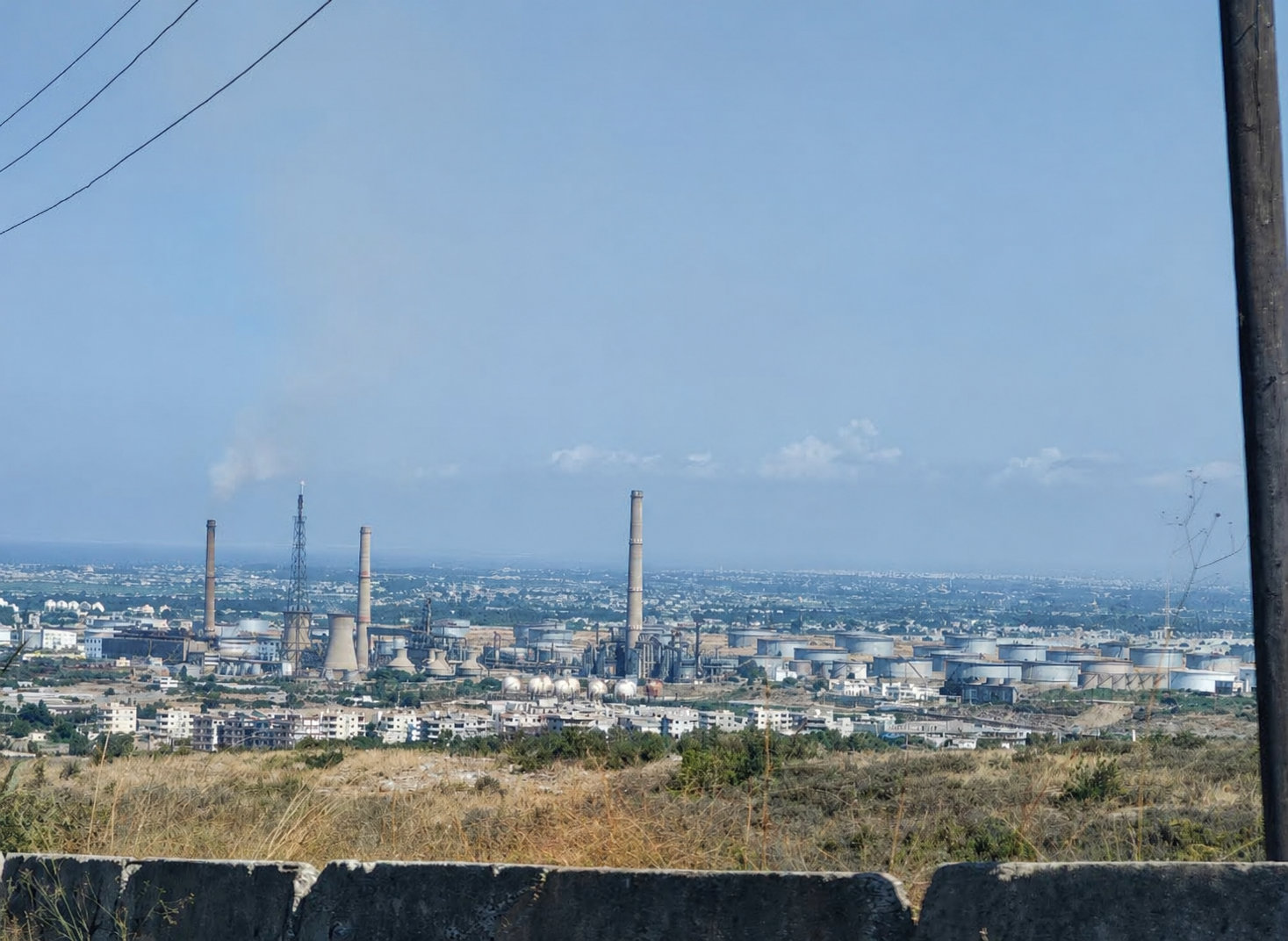
The port of Baniyas constitutes the project’s maritime terminus and is expected to require expansion and modernisation to handle substantial oil flows. Potential requirements include developing crude-receiving facilities, storage tanks, measurement systems, tanker-loading platforms, safety procedures, and oil-spill response capabilities.
These improvements could revitalise the port and increase its importance within energy traffic in the Eastern Mediterranean. They could also create demand for shipping, maintenance, insurance, and storage services, extending the project’s economic benefits beyond pipeline transit fees.
Baniyas’s geographical location offers an additional advantage by providing direct access to the Mediterranean and European markets. Converting this advantage into tangible revenue, however, would require improving the efficiency of the port and its surrounding facilities and ensuring their ability to operate in accordance with international technical and environmental standards.
Supporting the Baniyas Refinery
The pipeline could contribute to securing stable supplies for the Baniyas refinery if the agreements allocate part of the Iraqi oil for consumption or refining within Syria. This could help increase refinery utilisation rates and reduce shortages of petroleum products.
The project could also be linked to plans to rehabilitate the refinery and modernise its production units, particularly if international companies participate in the investment. This would allow Syria to benefit from Iraqi crude not merely as a transit commodity but as a resource that could be converted into petroleum products for domestic consumption or re-export.
This arrangement would nevertheless require a separate agreement defining the volumes allocated to Syria, their prices, and the payment mechanism. It should not be regarded as an automatic consequence of reactivating the pipeline.
Restoring Syria’s Role as a Regional Energy Corridor
Syria historically occupied an important position within the oil and gas transportation routes linking Iraq to the Mediterranean. Political disputes, wars, sanctions, and damage to infrastructure, however, caused this role to decline over recent decades.
Reviving the Kirkuk–Baniyas pipeline could return Syria to the map of regional energy corridors and make the stability of its territory and infrastructure a consideration for importing countries and international companies. It could also encourage proposals for additional projects involving electricity interconnection, gas transportation, and the development of ports, roads, and railway networks.
Restoring this role will depend on Damascus’s ability to provide a stable legal and security environment and ensure that operations continue without disruption from political volatility or armed interference.
Attracting Foreign Companies and Investment
Reconstructing the pipeline will require financing, technical expertise, and technology that cannot easily be provided through Syria’s domestic resources. The project therefore creates opportunities for international companies specialising in pipeline construction, pumping and storage facilities, and port management.
The participation of American or European companies could serve as an entry point for broader investment in Syria’s energy sector. It could also facilitate the transfer of expertise, workforce training, and improvements in operational and safety standards.
Conversely, financing or operating companies could gain substantial influence over the project’s management and contractual terms. Syria will therefore need to balance its need for investment with preserving ownership of its infrastructure and securing a fair share of the revenues.
Employment and Local Economic Activity
The project could create employment opportunities during both the construction and operational phases, including pipeline repairs, station construction, storage-tank rehabilitation, port development, security, transportation, and services.
Areas along the pipeline could also benefit from the construction of service roads and electricity and communications networks connected to the project. Transforming these investments into genuine local development, however, would require government plans ensuring that the benefits are not confined to companies and central authorities.
Clear mechanisms will also be necessary to compensate landowners and communities affected by construction work and to allocate part of the revenues to improving services in areas located along the pipeline route.
Strengthening Economic Relations with Iraq
The pipeline could establish a long-term economic relationship between Syria and Iraq that extends beyond conventional trade to the joint management of strategic infrastructure. The continuous flow of oil would give both parties a direct interest in maintaining stable political, security, and technical coordination.
Cooperation could expand into other areas, including supplies of petroleum products and gas, electricity interconnection, and overland transportation. The project would also give Syria an opportunity to reintegrate into regional initiatives after years of isolation and war.
This interdependence could nevertheless become a source of disagreement if mechanisms for resolving disputes, reviewing fees, and allocating responsibility for maintenance costs and damage caused by attacks or accidents are not defined from the outset.
Political Significance Beyond Financial Returns
Syria’s potential gains are not limited to direct revenues. The passage of part of Iraq’s exports through Syrian territory would link the country’s stability to the interests of Baghdad, investing companies, and oil-importing states.
This could give Damascus additional weight in its regional and international relations and support its transition from a country dependent on energy imports and assistance to one playing a role in energy transportation and security.
Nevertheless, the project could turn Syrian territory into an additional arena of competition among the United States, Iran, Turkey, and Russia, particularly if its operation becomes associated with shifting the balance of influence within Syria’s energy sector.
Syria’s benefit from the Kirkuk–Baniyas pipeline will therefore be measured not only by the value of transit fees but also by its ability to use the project to rebuild its infrastructure, revitalise the coast and the areas along the route, meet its oil requirements, and restore its position as an energy corridor without becoming politically or economically dependent on an external actor.
Fifth: The US and Iranian Dimensions of the Project
US support for reviving the Kirkuk–Baniyas pipeline carries implications that extend beyond economic and technical considerations. The project is being reconsidered at a time when energy export corridors have become a central component of the confrontation between the United States and Iran, while the ability to protect oil flows has become directly linked to deterrence dynamics and regional influence.
Washington views the diversification of oil export routes as a means of reducing Iran’s influence over global energy markets, particularly its ability to threaten navigation through the Strait of Hormuz. Tehran, in contrast, may view the establishment of a US-backed oil corridor through Iraq and Syria as an attempt to weaken one of its most important instruments of strategic pressure.
Reducing the Strategic Value of the Strait of Hormuz
The Strait of Hormuz is one of the world’s most important energy corridors. Its geographical location gives Iran the ability to threaten a substantial share of oil and gas exports originating in the Gulf. Tehran has used threats to close the strait or attack ships and surrounding facilities as part of its deterrence messaging towards the United States and its allies.
Overland pipelines cannot fully replace the strait because of the enormous volume of energy supplies passing through it. They can, however, reduce the scale of disruption caused by its closure. This highlights the importance of any pipeline capable of transporting Iraqi oil directly to the Mediterranean without passing through the Gulf.
Washington recognises that the effectiveness of Iran’s threat increases in proportion to producing countries’ dependence on Hormuz. US support for the Kirkuk–Baniyas pipeline therefore aligns with a broader strategy of distributing the region’s exports across several routes, thereby reducing Iran’s ability to influence global markets through a single maritime chokepoint.
Redirecting Iraq’s Energy Sector
The United States is seeking to expand the presence of American companies in Iraq’s energy sector after years of growing Chinese and Russian involvement. Interest in developing the Kirkuk oil fields and establishing new export routes forms part of an effort to reconnect sections of Iraq’s oil industry with Western companies and markets.
The involvement of American companies in financing, constructing, or operating the Kirkuk–Baniyas pipeline could give Washington an influential role in one of the most important cross-border energy infrastructure projects linking Iraq and Syria.
It would also allow the United States to connect increased production from Iraqi oil fields to export routes not directly subject to Iranian influence. This could help Washington strengthen Iraq’s position as an energy supplier to international markets while reducing its dependence on political and security arrangements affected by Tehran.
Limiting Iranian Influence in Iraq
Iran possesses extensive political, security, and economic influence inside Iraq, based partly on its relationships with political parties, armed factions, and commercial and financial networks. This influence gives Tehran the ability to affect a range of strategic Iraqi decisions.
From the US perspective, major projects connecting Iraq to Western markets and Arab states could help reduce its economic dependence on Iran. The Kirkuk–Baniyas pipeline is one such project because it would direct part of Iraq’s exports westward towards the Mediterranean rather than keeping them within the Gulf’s geographical sphere.
The project would not necessarily remove Iraq from Iran’s sphere of influence. Tehran retains political and security instruments inside the country and may be able to influence legislation, financing, corporate contracts, and the protection arrangements associated with the pipeline.
Syria Between US and Iranian Interests
The project becomes more sensitive because it passes through Syria, which has for years served as a principal corridor for Iranian influence towards Lebanon and the Eastern Mediterranean. Tehran has supported military and economic institutions and networks inside Syria and invested in strategic sectors and locations connected to transportation and energy.
The entry of the United States and Western companies into a project extending across Syrian territory raises questions about the future of Iranian interests in Syria’s energy sector and infrastructure. If the pipeline becomes part of a network operated or financed by American and international companies, it could limit Iran’s ability to control certain vital economic projects.
Washington could also use its support for the project to encourage Damascus to reduce its military and economic ties with Tehran in exchange for investment and international engagement. Under this scenario, the pipeline would evolve from an oil transportation project into an instrument for restructuring Syria’s regional relationships.
Iran’s Expected Position
Iran has no clear economic interest in supporting a route that reduces the importance of the Strait of Hormuz and strengthens the US presence in Iraq and Syria. Nevertheless, it may avoid openly opposing the project because of its relationships with the Iraqi and Syrian governments and its desire not to appear responsible for obstructing economic initiatives benefiting both countries.
Tehran may instead employ indirect means to influence the project, such as exerting political pressure on Iraqi actors, shaping the terms of agreements and contracts, or promoting the participation of companies and entities close to Iran.
Iran may also seek guarantees that the pipeline will not be used as part of a policy intended to isolate it, or demand that it be connected to broader regional projects that preserve an Iranian role in energy and trade flows.
Armed Factions as a Potential Instrument of Influence
The project passes through an environment containing armed groups, some of which maintain close relations with Iran, particularly in Iraq and on both sides of the Iraqi–Syrian border. This does not mean that these factions would automatically target the pipeline, but they could become an instrument of pressure if the confrontation between Tehran and Washington escalates.
Such pressure could take several forms, including political opposition, influence over security contracts, demands for the participation of local economic entities, or threats against operating companies. In the most serious scenario, pipelines or pumping stations could face limited attacks intended to disrupt the project or increase its operating costs.
The likelihood of targeting would increase if the pipeline were publicly presented as an American project intended to break Iranian influence, as this could turn it into a symbolic target within the confrontation between the two sides.
The US Presence and Security Requirements
The participation of American companies may require special security arrangements to protect personnel and infrastructure. These could include private security companies, aerial and electronic surveillance capabilities, and coordination with Iraqi and Syrian forces and international actors.
Any direct or indirect US security presence could provoke objections from Iran and Iran-aligned factions, particularly if it extended into sensitive areas near the Iraqi–Syrian border.
Washington may therefore seek to rely on local forces and surveillance technology while keeping its field presence limited. The ability of local forces to protect a long pipeline across a desert environment will nevertheless remain open to question.
The Project within the Reshaping of Regional Influence
If the Kirkuk–Baniyas pipeline moves from preliminary understandings to implementation, it could become an indicator of a changing regional balance of influence. The successful implementation of the project with US support would increase Iraq and Syria’s connection to Western companies and markets and relatively reduce Iran’s ability to control the economic corridors surrounding it.
Conversely, the project’s failure because of political disputes or security pressure could demonstrate Tehran and its allies’ continuing ability to influence strategic projects in Iraq and Syria.
The pipeline’s importance will therefore be determined not only by the volume of oil it carries but also by the parties that finance, manage, and protect it. Control over energy infrastructure provides long-term influence extending beyond financial returns to political decisions, security alliances, and each country’s position within the regional order.
Sixth: Turkey’s Position and Competition over Iraqi Oil Export Corridors
The Kirkuk–Baniyas project is directly connected to Turkish interests because Turkey hosts the Kirkuk–Ceyhan pipeline, the traditional outlet for transporting northern Iraqi oil to the Mediterranean. Establishing an Iraqi route through Syria would provide Baghdad with an additional option, but it could simultaneously reduce the importance of Turkish territory as the principal gateway for exports from the northern fields.
This does not mean that Ankara would automatically oppose the project. Its position will be determined by the new pipeline’s capacity, the volume of oil redirected towards it, and its impact on the Ceyhan route and Turkish interests in Iraq and Syria.
The Kirkuk–Ceyhan Pipeline and Turkey’s Importance to Iraq
For decades, the Kirkuk–Ceyhan pipeline has been one of Iraq’s most important oil export routes outside the Arabian Gulf. It transports crude oil from northern Iraq to the Turkish Mediterranean port of Ceyhan, providing Iraq with a shorter route towards European markets.
The Kurdistan Region of Iraq has also used networks connected to the Turkish route to export oil. This made Turkey an influential party in the complex relationship between the federal government in Baghdad and the Kurdistan Regional Government over the management of oil fields and revenues.
The Turkish route’s operation has, however, been affected by legal and political disputes, tensions between Baghdad and Erbil, attacks on pipelines, and disagreements over oil marketing and revenue distribution. These problems have encouraged Iraq to seek options that do not depend exclusively on understandings with Ankara.
Could Baniyas Compete with Ceyhan?
The Kirkuk–Baniyas pipeline could compete with the Turkish route if it succeeds in transporting substantial volumes of Kirkuk oil to the Syrian coast under more favourable financial terms. Possessing two routes to the Mediterranean would also reduce the ability of any single transit country to impose conditions or use suspension of operations as a means of pressure.
This could affect the transit fees received by Turkey and the importance of the port of Ceyhan within Iraq’s oil trade. The scale of the impact, however, would depend on the Baniyas pipeline’s actual capacity. If the project were limited in scope, it would not constitute a complete alternative to the Turkish route.
If the project involved constructing a high-capacity pipeline and connecting it to additional oil fields in northern and central Iraq, however, it could become a genuine competitor affecting the distribution of exports, contracts, and regional investment.
Turkey’s Options for Addressing the Project
Turkey has several options for responding to the pipeline’s revival. It could improve the terms for using the Kirkuk–Ceyhan pipeline and offer Iraq incentives to maintain export volumes passing through Turkish territory. Ankara could also accelerate the repair and expansion of infrastructure connected to the Turkish port.
Alternatively, Ankara could treat the project as a component of a larger regional network and seek to participate in investment or transportation arrangements connecting the pipelines of Iraq, Syria, and Turkey. This approach would allow it to preserve its role within the regional energy landscape even as export outlets become more diversified.
Turkey could also use its political and economic relations with Baghdad and its influence in northern Syria to shape the project’s structure, route, and operating conditions, particularly if the pipeline approaches areas where Turkey maintains a military or security presence.
The Project’s Impact on Baghdad–Erbil Relations
The project could have significant implications for relations between the Iraqi federal government and the Kurdistan Regional Government. Increasing the capacity to export Kirkuk oil through Syria could strengthen Baghdad’s control over exports from the northern fields and reduce its dependence on infrastructure connected to the Kurdistan Region and Turkey.
This could give the federal government additional leverage in negotiations over oil management and revenue sharing. The Kurdistan Regional Government, in contrast, may view the project as weakening its position as an important link in northern Iraq’s oil export network.
Arrangements could nevertheless be designed to connect some of the Kurdistan Region’s oil fields to the new route if Baghdad and Erbil reach a comprehensive agreement on production and export management. Under such circumstances, the pipeline could become part of a domestic oil settlement rather than an instrument for deepening the dispute.
Israel and the Eastern Mediterranean
The arrival of Iraqi oil on the Syrian coast carries significance within the Eastern Mediterranean energy landscape, where the interests of Turkey, Israel, Egypt, Cyprus, Greece, and European countries intersect.
The project would not necessarily compete directly with Eastern Mediterranean gas projects, but it would add new infrastructure capable of directing energy supplies towards European markets. This could prompt surrounding countries to monitor which parties manage the port of Baniyas and the nature of the international presence on the Syrian coast.
Israel is likely to view the project from two perspectives. The first concerns its potential contribution to reducing Iranian influence over energy flows. The second relates to the risks arising from the presence of strategic oil infrastructure near areas of Iranian influence or locations that could be used for military purposes.
Gulf States and the Interest in Diversifying Energy Corridors
The Gulf states may have a general interest in the success of projects that reduce regional dependence on the Strait of Hormuz, even if the Kirkuk–Baniyas pipeline is intended primarily for Iraqi oil. Every volume exported through an overland route would reduce pressure on the maritime corridor and limit the market impact of any potential closure.
Gulf companies and investment funds could also participate in financing parts of the project or developing the port of Baniyas if adequate political and security guarantees were available. Gulf investment could additionally be used to strengthen economic relations with Syria and reduce its dependence on Iran.
The involvement of the Gulf states would nevertheless remain connected to the US position, Syria’s stability, contractual conditions, and the level of risk facing capital and long-term projects.
The European Union and Security of Supply
The direct arrival of Iraqi oil in the Mediterranean gives the project significance for European countries seeking diversified energy sources. The route could shorten transportation times compared with shipments originating in the Gulf and provide an additional outlet if maritime traffic through Hormuz or the Red Sea were disrupted.
European companies could potentially participate in engineering, insurance, storage, and port management. European involvement, however, would require legal clarity regarding sanctions, contracts, and ownership, as well as guarantees concerning security, transparency, and environmental standards.
European countries would also pay close attention to the origin of the oil and its marketing mechanisms, seeking to prevent the project from being used for unlawful activities, the mixing of shipments, or the financing of armed groups.
Competition or an Integrated Network of Corridors?
The Kirkuk–Baniyas and Kirkuk–Ceyhan pipelines should not be viewed as though the success of one requires the suspension of the other. Iraq’s current production and its ambition to increase output allow for the simultaneous use of multiple routes.
The most advantageous option for Iraq would be to establish a multidirectional network encompassing the Gulf, Turkey, Syria, and potentially other outlets in the future. Such a network would give Baghdad flexibility to distribute exports according to prices, demand, and security risks.
The diversification of routes will nevertheless create competition among transit countries over fees, investment, and political influence. Turkey will likely seek to preserve its position, while Syria attempts to restore its former role. The United States, meanwhile, supports routes that reduce dependence on Hormuz and limit Iranian influence.
The Kirkuk–Baniyas pipeline consequently reopens competition over which country will become the principal gateway for Iraqi oil entering the Mediterranean. It also gives Iraq an opportunity to transform its position as a major oil producer into an instrument for balancing regional powers rather than remaining dependent on a single export route.
Seventh: Security Risks Along the Pipeline Route
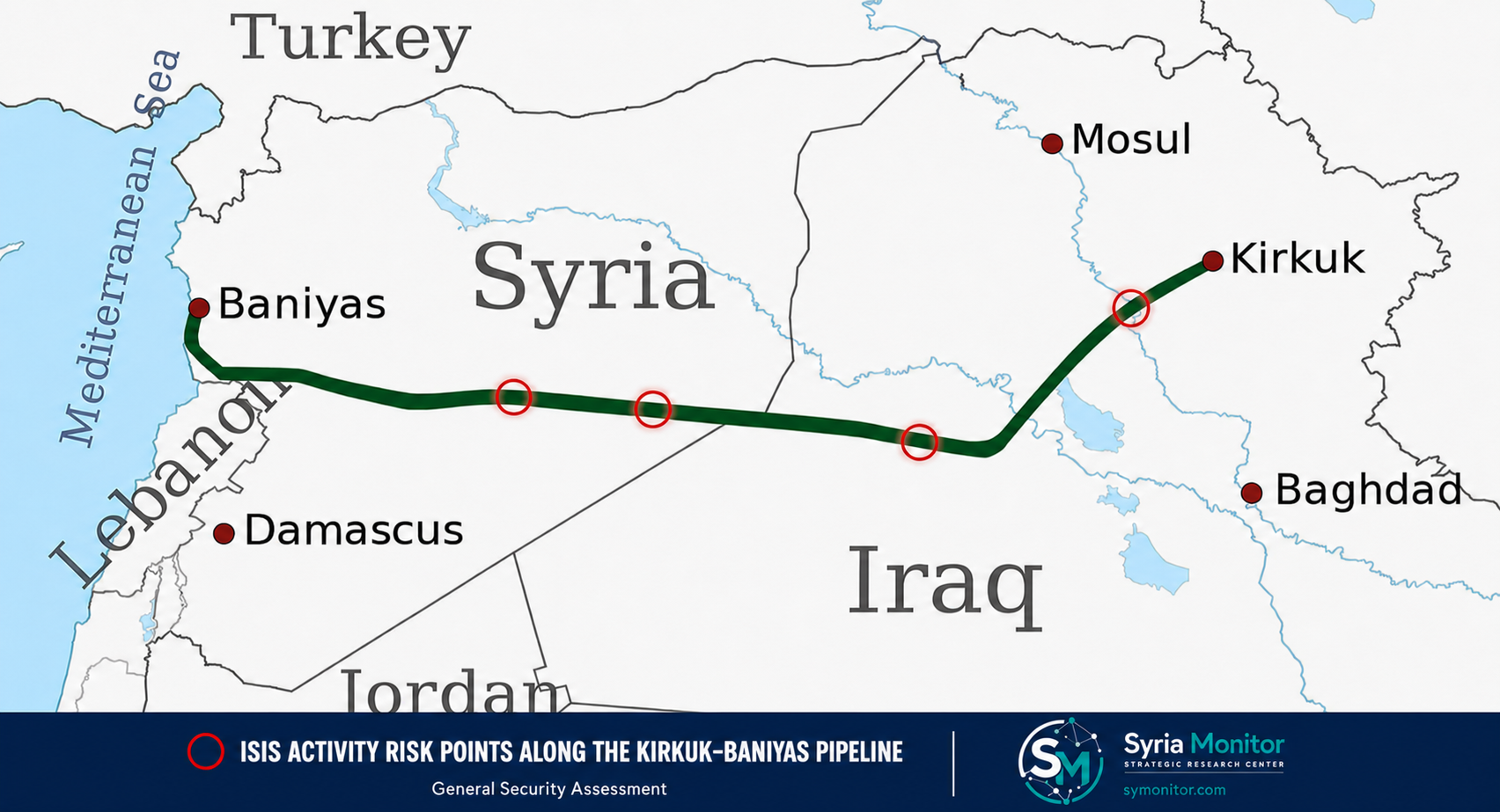
The Kirkuk–Baniyas pipeline passes through a complex security environment extending from northern and western Iraq to eastern and central Syria. Some of these areas have witnessed activity by ISIS, the presence of armed factions, and cross-border smuggling networks. The length of the route and its multiple stations make its permanent protection a challenge extending beyond the security requirements of a fixed facility.
The most significant threat consists of sabotage attacks targeting pipelines and pumping stations, whether to disrupt oil exports or extort the two governments and operating companies. The pipeline could also become a target within the confrontation between the United States and Iran, particularly if American companies participate in its management or it is presented as a strategic alternative to the Strait of Hormuz.
Operating the project will require the establishment of a joint Iraqi–Syrian security mechanism encompassing aerial and electronic surveillance, the protection of pumping stations, and information sharing regarding the movements of armed cells. Protection contracts must also be prevented from becoming a source of influence or financing for local factions, as the involvement of multiple security actors could increase the project’s vulnerability rather than protect it.
Eighth: Technical and Economic Challenges
The old pipeline has sustained extensive damage, while substantial sections have exceeded their operational lifespan. This means that comprehensive repairs may not be economically viable compared with constructing a new pipeline alongside the historic route.
The two governments need to conduct a comprehensive technical assessment of the condition of the pipelines, pumping stations, storage tanks, and maritime facilities in Baniyas. The targeted transport capacity must also be precisely defined, with a clear distinction between the old pipeline’s capacity and the substantially higher figures being discussed for the new project.
Other challenges include high construction costs, difficulties in securing financing, determining transit fees, and allocating maintenance and protection responsibilities. The project will remain vulnerable to delays as long as the agreements remain non-binding memoranda of understanding and are not converted into implementation contracts specifying financing, timelines, and the operating entity.
Ninth: Potential Scenarios
Scenario One: Partial Reactivation
Some sections of the pipeline would be repaired and operated at limited capacity. This would be the fastest scenario, but it would not provide a substantial alternative to the southern ports or the Strait of Hormuz.
Scenario Two: Construction of a New Pipeline
International companies would construct a new high-capacity pipeline while developing the pumping stations and the port of Baniyas. This would be the most consequential scenario, but it would require substantial financing and long-term political and security guarantees.
Scenario Three: Phased Implementation
The project would begin by repairing sections capable of returning to operation while simultaneously constructing new sections and gradually expanding capacity. This appears to be the most realistic scenario because it distributes costs and risks across several stages.
Scenario Four: Project Stagnation
The preliminary understandings would remain unimplemented because of political disputes, insufficient financing, or deteriorating security conditions. Iranian pressure, regional competition, and a lack of contractual clarity could also delay or freeze the project.
Tenth: Findings and Strategic Assessments
Current indications suggest that the return of the Kirkuk–Baniyas pipeline reflects a genuine Iraqi need to diversify export outlets rather than merely an attempt to restore a historic project. US support and the potential participation of international companies also give the project significance extending beyond relations between Baghdad and Damascus.
The project could give Iraq direct access to the Mediterranean while providing Syria with revenue, investment, and a renewed regional role. It would not, however, constitute a complete alternative to the Strait of Hormuz, but rather an additional route mitigating some of the associated risks.
The identities of the financing and operating companies will likely influence Iran’s position towards the project. The more closely the pipeline is associated with US policy to limit Tehran’s influence, the greater the likelihood that it will face indirect political or security pressure.
Its operation would also increase competition between Syria and Turkey over Iraqi oil exports to the Mediterranean. In return, however, it would give Baghdad greater room for manoeuvre and stronger negotiating leverage with transit countries.
Eleventh: Recommendations from Syria Monitor
-
Conduct an independent technical assessment before determining the project’s cost and operational capacity.
-
Adopt a phased implementation approach to reduce financial and security risks.
-
Establish a joint Iraqi–Syrian coordination centre to protect the route and exchange information.
-
Unify the security bodies responsible for protection and prevent the involvement of unofficial armed formations.
-
Publicly disclose contracts, transit fees, and financing mechanisms to ensure transparency.
-
Allocate part of the revenue to developing the areas along the pipeline route.
-
Develop the port and refinery of Baniyas alongside the pipeline’s construction.
-
Avoid relying on the pipeline as a standalone outlet and instead incorporate it into a diversified Iraqi export network.
-
Establish guarantees preventing the project from being used as an instrument in regional conflicts.