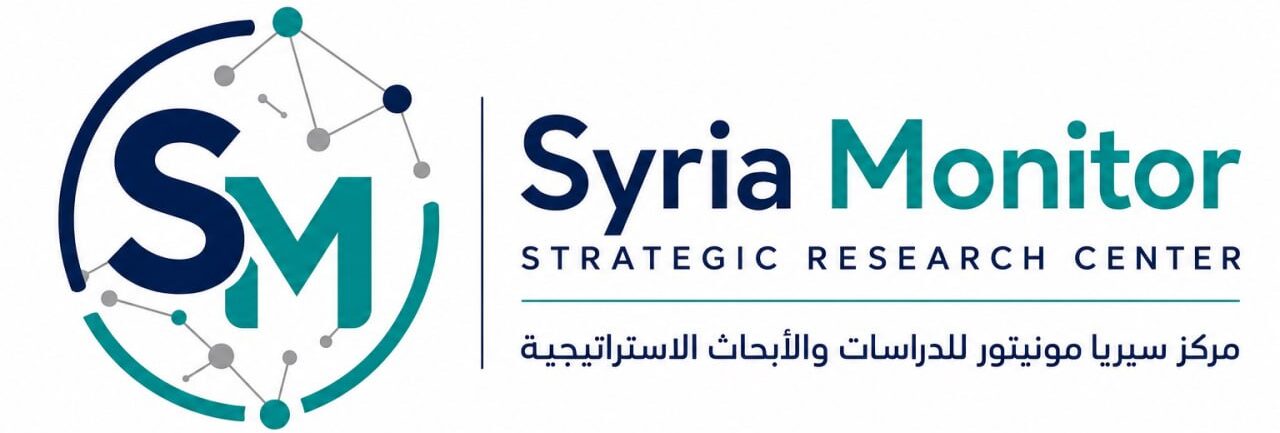
THE FINANCIAL NETWORK OF THE ISLAMIC REVOLUTIONARY GUARD CORPS — QUDS FORCE IN IRAQ AND SYRIA
- June 26, 2026
- Posted by: Syria Monitor
- Categories: Economy & Illicit Networks, RESEARCH
Syria Monitor Strategic Research Center
مركز سيريا مونيتور للدراسات والأبحاث الاستراتيجية
Strategic Research Paper
THE FINANCIAL NETWORK OF THE ISLAMIC REVOLUTIONARY GUARD CORPS — QUDS FORCE
IN IRAQ AND SYRIA
Architecture — Channels — Individuals — Entities — Financing and Smuggling Mechanisms
Open-Source Intelligence Analysis | OFAC Documentation | June 2026
Prepared by Syria Monitor Strategic Research Center
Syria Monitor assesses with high confidence that the financial network associated with the Islamic Revolutionary Guard Corps — Quds Force (IRGC-QF) entered a broad operational re-adaptation phase from 2025 onward, driven by tightening American and international oversight of banks, shipping firms, general trading companies, and cryptocurrency networks.
International pressure has not dismantled the network; rather, it has compelled the network to place greater reliance on commercial intermediaries, money transfer and exchange companies, informal financial fund systems, and stablecoin instruments — primarily USDT on the Tron blockchain.
The available evidence indicates that Iraq has become a significantly more important financial and logistical clearinghouse for the network following the fall of the Assad regime, given the marked decline in IRGC-QF’s capacity to use Syrian territory as a reliable transit corridor since December 2024. Concurrently, commercial channels linking Syria, Turkey, Iraq, Lebanon, and the UAE have expanded, with local companies and transfers operating through internal fund mechanisms and non-banking account codes that allow value settlement without direct movement of funds through the formal financial system.
Summary Assessments
◆ Iraq has emerged as the primary financial node for IRGC-QF operations across the Levant during 2025–2026.
◆ Tightened international oversight has driven the network toward more flexible instruments: internal financial funds, small transfer companies, commercial intermediaries, and informal value settlement.
◆ Cryptocurrencies — principally USDT on the Tron network — now function as a settlement layer between intermediaries rather than a comprehensive alternative to cash or hawala.
◆ The financial fund (Sanduq) system represents an evolved form of traditional hawala, in which each trader, company, or intermediary maintains an internal fund with a unique code through which payments are registered and subsequently settled.
◆ Financial corridors linking Syria, Turkey, Iraq, Lebanon, and the UAE have grown in strategic importance, enabling the movement of value rather than physical currency alone.
◆ Network resilience derives not from the strength of any single node, but from the multiplicity of intermediaries and the diversity of settlement pathways.
I. Executive Summary
The IRGC Quds Force — the external operations arm of Iran’s Islamic Revolutionary Guard Corps — operates what analysts consider the most structurally complex and adaptive financial network in the Middle East. Over several decades, the Quds Force has developed a multi-layered financial infrastructure that blends ostensibly legitimate economic instruments with systematic smuggling and money-laundering operations, designed to sustain its regional proxies across Iraq, Syria, Lebanon, and Yemen.
Documentation from the U.S. Department of the Treasury’s Office of Foreign Assets Control (OFAC) and open-source intelligence reporting indicates that this network is not merely a financing mechanism, but an integrated system that grants the Quds Force access to Iraqi and Syrian economic resources, generating autonomous revenues that reduce its dependence on Iran’s formal state budget — particularly significant given mounting economic pressures on Tehran.
This paper maps the network’s trilateral architecture, primary funding sources, transfer and storage channels, documented individuals, and active front entities, while providing an analytical assessment of the post-Assad structural shifts and operational developments through mid-2026.
~$5 Billion
Shadow transfers documented in 2024 (FinCEN) $8–11 Billion
Estimated Iranian crypto ecosystem size, 2025
$4 Billion
Transactions by Iran-linked oil companies in 2024 ~50%
Share of Iranian crypto linked to IRGC (Chainalysis est.)
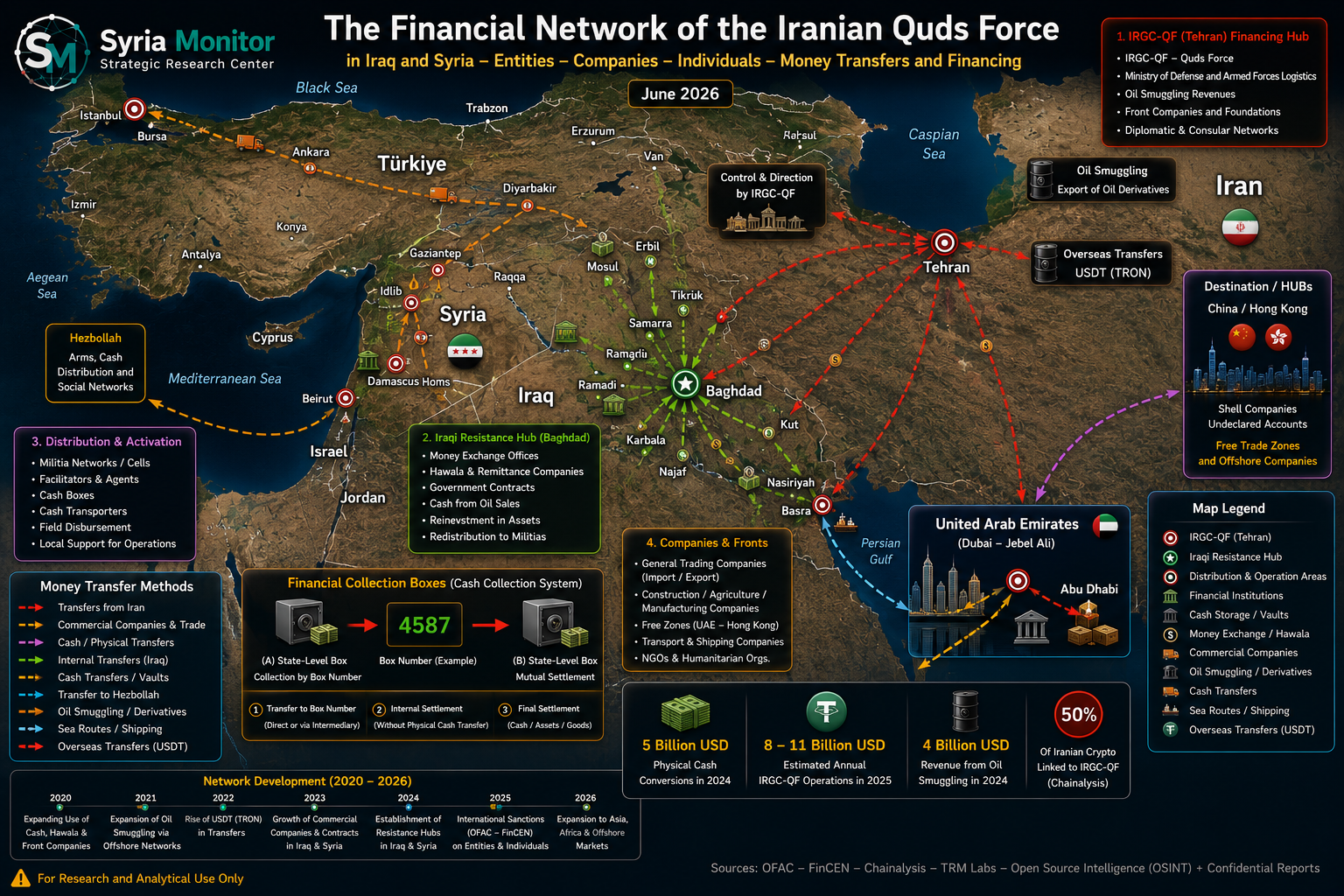
Condensed Network Flow Map
Tehran / IRGC-QF ➜ Oil revenues, trade, crypto ➜ Shell companies & shipping firms ➜ UAE / HK / China
➜ Iraq (primary clearinghouse) ➜ Syria, Lebanon, Turkey via transfer firms & traders ➜ Proxies & factions
II. Network Architecture
The IRGC-QF financial network is not a unitary institution but a multi-tiered architecture deliberately designed for resilience under sanctions pressure. It integrates formal sector instruments, parallel economy mechanisms, and modern digital tools in a configuration that resists comprehensive targeting.
Tier One: The Originator Layer — Tehran
Iran constitutes the network’s primary funding base. Revenue streams include:
◆ IRGC-QF operational budgets drawn from consolidated Iranian state allocations
◆ The Iranian Ministry of Defense and Armed Forces Logistics (MODAFL)
◆ Revenues from oil smuggling and off-channel crude sales
◆ Earnings from IRGC-affiliated industrial and commercial enterprises operating within Iran
◆ Independent financing networks operating through diplomatic and consular offices
Tier Two: The Intermediary Layer — Channels
This layer represents the most operationally complex tier and encompasses:
◆ Hawala dealers and informal exchange networks across Iraq, Lebanon, and the UAE
◆ Shell companies (front entities) registered in free trade zones — primarily the UAE and Hong Kong
◆ Iraqi commercial banks under the control of Quds Force-aligned figures
◆ Diplomatic networks and nominally humanitarian or non-governmental organizations used as cover
◆ Cryptocurrency pathways (predominantly USDT on the Tron network)
◆ Shipping brokers for Iran’s shadow fleet
Tier Three: The Beneficiary Layer — Proxies
The network’s downstream beneficiaries in Iraq, Syria, and Lebanon include:
◆ Kataib Hezbollah (Iraq) — the primary recipient
◆ Asa’ib Ahl al-Haq
◆ Harakat al-Nujaba
◆ Iran-aligned Popular Mobilization Forces (PMF) factions
◆ Lebanese Hezbollah, via Syrian transit corridors
◆ IRGC-QF intelligence units and security apparatuses operating in Syria
III. Primary Funding Sources
3.1 Oil Smuggling — The Core Revenue Stream
Petroleum remains the network’s most important and sustainable financial pillar. Following the reimposition of U.S. sanctions on Iranian oil exports, the IRGC developed a sophisticated architecture to circumvent these restrictions:
Mechanism Iranian crude is smuggled via a ‘shadow fleet’ — aging or poorly maintained vessels owned by shell companies registered outside Iran, predominantly in Iraq, the UAE, and Hong Kong.
Obfuscation Iranian crude is blended with oil from other jurisdictions and reclassified under falsified documentation — most commonly labeled as ‘Malaysian blend’ — before sale to small independent refineries in China colloquially known as ‘teapot refineries.’
Scale FinCEN analysis (2025) indicates that Iran-linked oil companies conducted approximately $4 billion in transactions in 2024, while associated shipping companies registered activity of approximately $707 million.
The smuggling network deploys multiple technical concealment tools: disabling AIS (Automatic Identification System) transponders, executing flag and name changes following the designation of prior owners on sanctions lists, and conducting ship-to-ship transfers in unmonitored maritime zones.
3.2 Cryptocurrency — A Rising Instrument
Cryptocurrencies represent a qualitative evolution in the network’s capacity to circumvent sanctions and the international banking system:
◆ Iran’s cryptocurrency ecosystem is estimated at between $8 and $11 billion in 2025
◆ Chainalysis estimates that up to 50% of this ecosystem may be linked to the IRGC
◆ Preferred instrument: USDT (Tether) on the Tron network — valued for low transaction fees and high liquidity
◆ Between 2023 and 2025: more than $100 million in cryptocurrency was procured in exchange for Iranian oil sales to the Iranian government (OFAC documentation)
◆ January 2026: The U.S. Treasury sanctioned two UK-licensed cryptocurrency exchanges for processing substantial funds linked to IRGC-controlled entities — the first action of its kind
◆ TRM Labs: One of the exchanges facilitated transactions exceeding $1 billion for parties under IRGC control
3.3 Extraction from the Iraqi Economy
Iraqi state assets constitute a critical funding source exploited through multiple pathways:
◆ Seizure of commercial bank control and leveraging these institutions to launder funds and transfer value to Iran
◆ Directing Iraqi government contracts to front companies affiliated with Iran-aligned PMF factions
◆ Exploiting government positions — such as the presidency of the Olympic Committee — to provide cover for financial operations
◆ Oil and narcotics smuggling by individuals protected by diplomatic or governmental status
3.4 Commercial Contracting and Front Entities
The systematic approach involves establishing companies operating across diverse sectors — construction, agriculture, mining, services — which secure government contracts worth hundreds of millions, with a portion of revenues channeled into the Quds Force’s financial network.
IV. Transfer and Receipt Channels
4.1 Hawala Networks
Hawala networks constitute the network’s historical backbone. Operating on the principle of bilateral offset settlement — funds are paid to an intermediary on one end and settled on the other without physical movement of currency — these systems render legal tracking nearly impossible:
◆ Hawala dealers provide immediate liquidity and a trusted informal infrastructure
◆ All Iran-aligned factions maintain their own hawala agent nodes
◆ Operations are geographically distributed: Baghdad, Basra, Karbala, Damascus, Beirut, Tehran
◆ Key detection indicators: large round-number transfers and rapid fund movement between companies in unrelated commercial sectors
4.2 Shadow Banking Networks — The UAE / Hong Kong / China Model
FinCEN’s May 2026 advisory mapped the principal fund flow pathway:
Iran (IRGC-QF) ► Non-Resident Accounts China / Hong Kong ► UAE Free-Trade Zone Shell Companies ► Iraq / Syria Proxies
The aggregate volume of these transfers was estimated at approximately $5 billion in 2024 alone, according to FinCEN’s financial analysis published in October 2025.
4.3 Internal Financial Fund (Sanduq) System — The Operational Model
The Sanduq (fund) system represents one of the most significant operational shifts within the network during 2025–2026. Under this model, physical or inter-bank movement of funds is not required. Instead, transactions are recorded within a private internal fund maintained by each trader, transfer company, or exchange office:
◆ Each fund is assigned an internal code or identifier used to register transactions and reconcile payments across multiple jurisdictions
◆ Payment is made in one country; the equivalent value is delivered in another; final settlement occurs later through trade, cash, USDT, or a reverse hawala
◆ The system reduces the regulatory footprint because it converts cross-border transfers into internal clearinghouse operations between intermediaries
◆ Fund operators may present as trading companies, exchange offices, food traders, import-export firms, or cryptocurrency brokers
4.4 Trans-Regional Fund Pathways: Syria–Turkey–Iraq–Lebanon–UAE
Analytical assessments indicate the presence of an enabling environment for Sanduq activity across the corridor linking Syria, Turkey, Iraq, Lebanon, and the UAE — combining licensed transfer companies, local exchange offices, import-export traders, hawala networks, and cryptocurrency brokers in a structure that permits multi-layered value settlement.
Country / Region Probable Network Role Primary Instruments
Iraq Primary clearinghouse and distribution hub for funds destined for factions and Syria Financial funds, cash, hawala, local banks, traders
Syria Receipt and local settlement point following collapse of prior formal channels Exchange offices, cash, traders, transfer companies
Turkey Commercial and financial transit corridor via traders and shipping/transfer companies Hawala, trade, Sanduq funds, USDT
Lebanon Settlement node linked to Hezbollah and exchange networks Cash, USDT, money changers, hawala
UAE Hub for commercial front entities and external settlement Trading companies, bank accounts, USDT, general trade
4.5 Diplomatic Channels and Civil Society Cover
OFAC documentation has recorded the Quds Force’s use of multiple cover channels: Iranian diplomatic missions in Iraq, Syria, and Beirut function as conduits for funds and operational directives; humanitarian and relief organizations serve as fronts for financial and logistical operations; and diplomatically affiliated companies linked to consular offices are used to manage bank accounts and conduct commercial transactions.
V. Documented Individuals
The table below lists individuals documented in sanctions designations or open-source investigative reporting with direct relevance to the financial network in Iraq and Syria. Additional names and expanded profiles may be incorporated into subsequent editions of this paper.
Name Nationality / Status Role Designation Status
Aqeel Muftin Khafif al-Baydani Iraqi — President, National Olympic Committee Managed an IRGC-linked bank; laundered tens of millions for Iran; oil and narcotics smuggling OFAC designated October 2025
Ali Muftin Khafif al-Baydani Iraqi — brother of above Partner in managing the same banking and financial network OFAC designated October 2025
Ali Muhammad Ghulam Husayn al-Ansari Iraqi banking official Money laundering; manipulation of the Iraqi banking system; transfer of millions to Iran OFAC designated October 2025
Hassan Qahtan al-Sa’idi Commander, Kataib Hezbollah / Baghdad Ran an intelligence collection network targeting U.S. forces in coordination with IRGC-QF officers OFAC designated October 2025
Muhammad Qahtan al-Sa’idi Iraqi — son of above Intelligence collection on behalf of Iran OFAC designated October 2025
Haytham Sabih Sa’id Iraqi — associate of the Sa’idi network Intelligence collection on behalf of IRGC-QF OFAC designated October 2025
Shibl Muhsin Ubayd al-Zaidi Iraqi — IRGC-QF financial coordinator Financial coordination between IRGC-QF and armed groups; Iranian oil smuggling to Syria; deployment of Iraqi fighters OFAC designated (prior)
Makki Kazim Abd al-Hamid al-Asadi Iraqi — logistics broker Facilitation of IRGC-QF shipments to Iraq; assisting IRGC-QF access to the Iraqi financial system OFAC designated
Muhammad Husayn Salih al-Hasani Iraqi — SWRC authorized agent Registered SWRC in Iraq in 2013; signed arms contracts in its name OFAC designated
Amir Dianat Iranian-Iraqi dual national Supported IRGC-QF smuggling operations including missile shipments; controls Taif Mining Services LLC OFAC designated 2020
Muhammad Husayn Shamkhani Iranian — principal financial intermediary Uses networks of vessels, shipping companies, and shell firms to launder billions in Iranian and Russian oil revenues OFAC designated July 2025
Ali Reza Darakhshan Iranian — crypto intermediary Coordinated purchase of over $100M in cryptocurrency in exchange for Iranian oil sales, 2023–2025 OFAC designated September 2025
Arash Ostaki Alivand Iranian — crypto intermediary Partner of Darakhshan; facilitated crypto transactions for the Iranian government and IRGC OFAC designated September 2025
Syrian money changer (unnamed publicly) Syrian national — Lebanon-based Provided Hezbollah with digital wallets linked to IRGC-QF commodity sales; facilitated crypto transfers to Hezbollah officials OFAC designated March 2024
* Additional names and expanded profiles may be incorporated into subsequent editions of this paper.
VI. Documented Entities and Front Companies
Entity Functional Role Legal Status
South Wealth Resources Company (SWRC) (Manabiaa Tharwat al-Janub General Trading Company) Transferred hundreds of millions in weapons to Iran-aligned PMF; moved millions of dollars to Iraqi militias; paid commissions to Abu Mahdi al-Muhandis OFAC designated 2019
Al-Muhandis General Company for Construction, Engineering, Mechanics, Agriculture & Industrial Contracting Economic conglomerate established by Kataib Hezbollah; channels Iraqi government funds; platform for economic control over PMF OFAC designated October 2025
Balduna for Agricultural Investments Front company for Al-Muhandis General Company; used to receive government contracts and launder proceeds OFAC designated October 2025
Taif Mining Services LLC Front entity for Amir Dianat’s logistics operations; used for shipping operations and vessel access facilitation OFAC designated 2020
Global Cleaners S.A.R.L. Linked to al-Zaidi and Hezbollah financier Adham Tabaja; provided protection for Hezbollah-funded companies in Iraq OFAC designated 2016
Iraqi commercial bank (Muftin-managed) Money laundering for Iran; financing of armed factions; exploitation of government position for cover OFAC designated October 2025
Wafa Telecom (سوريا) Syrian telecommunications company; confirmed IRGC-QF links established in OCCRP / Syrian Network for Human Rights investigation, December 2022 Documented: OCCRP 2022
Rahbar Companies (multiple UAE/HK entities) Trading companies registered in UAE and Hong Kong free trade zones; used to channel billions in Iranian oil revenues via China and the UAE Under active monitoring: FinCEN 2025–2026
Two UK-licensed cryptocurrency exchanges (unnamed publicly) Processed substantial funds for IRGC-controlled entities; one exchange facilitated over $1 billion in transactions for IRGC-aligned parties OFAC designated January 2026
VII. Fund Storage and Utilization
7.1 Storage Mechanisms
◆ Bank accounts held by shell entities or loyalist-controlled institutions in the UAE, Hong Kong, and Oman
◆ Physical cash within militia networks and weapons storage facilities across Iraq and Syria
◆ Cryptocurrency wallets — primarily USDT on the Tron network
◆ Iraqi real estate and commercial enterprises registered under intermediary names rather than IRGC-QF entities directly
◆ Deposits in Iraqi banks under the effective control of Iran-aligned factions
7.2 Documented Expenditure Categories
Network revenues are deployed across an integrated set of operational objectives:
◆ Salaries and stipends for Iran-aligned armed factions in Iraq and Syria
◆ Weapons procurement: ballistic missiles, unmanned aerial vehicles (UAVs), explosives
◆ Advanced weapons program development within Iran
◆ Political patronage and financing of parties and parliamentary blocs in Iraq
◆ Funding intelligence, surveillance, and information collection networks — including targeting of U.S. forces
◆ Economic investments to generate self-sustaining autonomous revenues
◆ Narcotics smuggling operations, which in turn generate additional financial flows
◆ Funding IRGC-QF affiliated media and information operations across the region
VIII. Syria After the Assad Regime: Structural Consequences for the Network
The fall of Bashar al-Assad’s government on December 8, 2024 constituted a structural rupture in the geographic architecture of the IRGC-QF financial network. Syria had functioned as:
◆ The critical overland corridor linking Iraq and Lebanon for the movement of funds and weapons
◆ The forward deployment zone for Quds Force units and advisory personnel
◆ A center for Iranian economic ventures in reconstruction, telecommunications, and energy
◆ A transit point for the financing of Lebanese Hezbollah
8.1 Immediate Consequences
The fall of the regime resulted in a significant loss of direct Quds Force presence, though the financial networks did not collapse immediately:
◆ Companies linked to Hezbollah financiers continued operating with relative freedom within the Syrian economy into early 2026, according to Foundation for Defense of Democracies (FDD) reporting
◆ Wafa Telecom and other entities documented in OCCRP reporting require continued close regulatory monitoring
◆ Syria’s new government is attempting to decouple public institutions from Iranian networks, though this process is complex and incremental
8.2 Reorientation Toward Iraq
The loss of Syria as a transit corridor has intensified pressure on the Iraqi network as the primary alternative, elevating the al-Qaim–Abu Kamal border crossing to greater strategic importance than it previously held. Dependence on direct maritime and air channels from Iran has correspondingly increased.
IX. Chronology of Key Enforcement and Regulatory Developments (2024–2026)
Date Development
March 2024 OFAC sanctions a Syria-born Lebanon-based money changer for providing Hezbollah with digital wallets linked to IRGC-QF commodity sales and facilitating cryptocurrency transfers to Hezbollah officials.
July 2025 OFAC designates Muhammad Husayn Shamkhani for using shipping networks and shell companies to launder billions derived from Iranian and Russian oil revenues.
September 2025 OFAC targets Darakhshan and Alivand for procuring over $100M in cryptocurrency in exchange for Iranian oil sales between 2023 and 2025.
October 2025 Major OFAC enforcement action: designation of an Iraqi network encompassing Al-Muhandis General Company, Balduna, the Muftin brothers, and PMF intelligence operatives.
January 2026 OFAC designates the first two UK-licensed cryptocurrency exchanges for processing funds for IRGC-controlled entities — a legal precedent. One exchange facilitated over $1 billion in relevant transactions (TRM Labs).
February 2026 The European Union formally lists the IRGC as a terrorist organization following domestic crackdowns, significantly broadening the European sanctions framework.
March 2026 FinCEN estimates total Iranian shadow banking activity in 2024 at approximately $9 billion.
May 2026 FinCEN issues a comprehensive advisory identifying 14 red flags to assist financial institutions in detecting potential IRGC financing exposure.
X. Detection Indicators and Strategic Assessment
10.1 FinCEN Red Flags (2026 Advisory)
FinCEN’s May 2026 advisory identified 14 red flags for financial institutions. The most operationally significant indicators include:
◆ Wire transfers or deposits with incomplete or absent source-of-funds information, involving entities in high-risk jurisdictions
◆ General trading companies with opaque ownership structures registered in UAE free trade zones, with counterparties in Singapore and Hong Kong
◆ Transactions referencing ‘Malaysian blend crude’ involving vessels transiting Southeast Asia en route to China and exhibiting AIS anomalies
◆ Vessels with multiple recent changes of name, flag, or ownership — particularly following the designation of a prior owner on sanctions lists
◆ Entities conducting large, round-number transactions coupled with rapid fund movement between companies in unrelated commercial sectors
◆ Financial fund (Sanduq) systems: recurring fund codes across multiple jurisdictions; frequent small transfers to the same intermediary; transfer companies with limited commercial activity but high financial throughput
10.2 Strategic Risk Matrix
Channel / Instrument Risk Level Rationale
Oil Smuggling CRITICAL Massive and sustainable revenue source; obfuscable through trade documentation and maritime logistics
Front / Shell Companies CRITICAL Provide apparent legal cover; embedded in contracting and commercial systems
Financial Fund (Sanduq) System CRITICAL Transfers value without direct inter-bank movement; structurally resistant to standard surveillance
USDT / Tron Cryptocurrency HIGH Fast, low-cost; functions as a settlement layer between intermediaries
Traditional Hawala HIGH Socially embedded; operates outside direct banking oversight
Syrian Corridor MEDIUM Diminished but not eliminated following the regime’s fall; continues at reduced capacity
UAE / HK / China Nodes CRITICAL Principal hubs for shell companies, accounts, and commercial settlements
10.3 Intelligence Gaps Requiring Continued Investigation
◆ Names of transfer and exchange companies operating between Iraq, Syria, Turkey, Lebanon, and the UAE
◆ Fund codes or internal identifiers used in settlement operations
◆ Identities of traders and brokers associated with specific Sanduq nodes
◆ USDT wallets used by intermediaries, particularly on the Tron network
◆ Relationships between trading companies, exchange offices, and shipping brokers
◆ Final settlement mechanisms: cash, commodities, real estate, gold, or digital transfers
◆ Parties receiving funds inside Iraq, Syria, and Lebanon following clearinghouse completion
XI. Forward Assessment: 2026–2028
Syria Monitor assesses that the network will continue its structural evolution toward greater decentralization during 2026–2028, relying on a larger number of smaller-scale intermediaries rather than large, exposed entities. Dependence on stablecoins, local transfer companies, internal financial funds, and cross-border trade as cover for settlements will increase.
Accordingly, traditional sanctions pressure targeting named entities alone will prove increasingly insufficient unless accompanied by pattern-level tracking of intermediary activity, Sanduq fund codes, digital wallet behavior, and recurring cross-border trade networks. The network’s defining characteristic — structural resilience — means that the disruption of any single node is absorbed and compensated for by alternative pathways with minimal operational delay.
Structural Resilience: The Defining Feature
The IRGC-QF financial network in Iraq and Syria is characterized by structural resilience: when a single node is targeted, the network reconstitutes itself around alternative nodes with minimal operational delay. This property renders comprehensive dismantlement through economic pressure alone exceptionally difficult. The network’s capacity to survive does not derive from the strength of any individual node, but from the multiplicity of intermediaries and the diversity of settlement pathways — a distributed architecture deliberately engineered for persistence.
Sources and Methodology
Official Documentation
◆ U.S. Department of the Treasury, Office of Foreign Assets Control (OFAC) — Designation notices and supporting documentation, 2016–2026
◆ U.S. Financial Crimes Enforcement Network (FinCEN) — Financial intelligence advisories, May 2026 and June 2025
◆ U.S. Department of State — Terrorist Designation Program documentation
Investigative and Open-Source Reporting
◆ Organized Crime and Corruption Reporting Project (OCCRP) — Syrian financial networks investigation, December 2022
◆ Foundation for Defense of Democracies (FDD) — Iran sanctions and proxy financing research, 2024–2026
◆ Syrian Network for Human Rights — Economic entity documentation
◆ TRM Labs — Cryptocurrency compliance and IRGC-linked exchange analysis, 2025–2026
◆ Chainalysis — Iranian cryptocurrency ecosystem estimates, 2025
Academic and Policy Research
◆ Council on Foreign Relations (CFR) — Iran sanctions policy assessments
◆ Association of Certified Anti-Money Laundering Specialists (ACAMS) — Typologies research
◆ CommandEleven and StrategyBattles — IRGC network open-source mapping
Methodological Note
This paper is based exclusively on open-source information: official government designations and supporting documentation, peer-reviewed investigative journalism, registered think-tank research, and financial intelligence advisories. No classified information was used. All financial figures cited are drawn from official U.S. government documentation or reputable financial intelligence firms. Individuals listed in Section V appear solely on the basis of formal government designations or documented investigative findings; this paper makes no independent legal determination of culpability.
June 2026 | Syria Monitor Strategic Research Center
مركز سيريا مونيتور للدراسات والأبحاث الاستراتيجية