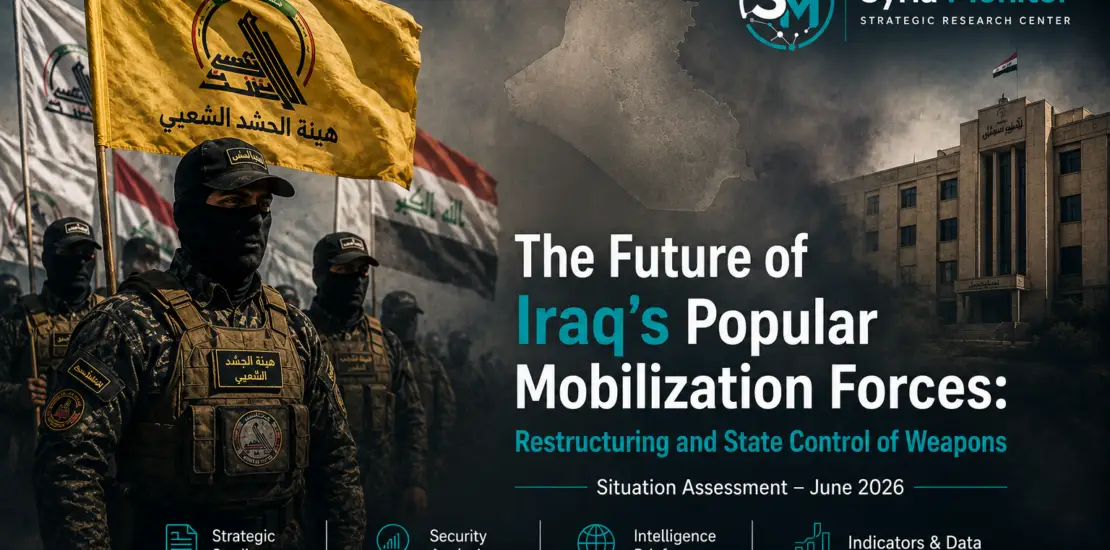
The Future of Iraq’s Popular Mobilization Forces (PMF): Restructuring and State Control of Weapons
- June 9, 2026
- Posted by: Syria Monitor
- Category: SITUATION ASSESSMENT
Syria Monitor Strategic Research Center
Since 2025, Iraq has witnessed growing debates regarding the future of the armed factions operating under the umbrella of the Popular Mobilization Forces (PMF), amid increasing domestic, regional, and international pressure to place all weapons under state control and redefine the relationship between armed factions and official security institutions.
These discussions come at a sensitive time marked by rapid regional transformations and mounting international pressure on Baghdad to regulate weapons outside the authority of the state. The debate has intensified alongside developments following the Iran–Israel conflict and the broader security changes taking place across Iraq and Syria.
Although no official decision has been issued to dissolve or dismantle the PMF, current indicators suggest a gradual process aimed at reorganizing certain factions and integrating portions of their military capabilities into state institutions, while significant disagreements remain regarding the scope and limits of such reforms.
The Popular Mobilization Forces were established in 2014 following the “Jihad al-Kifa’i” fatwa issued in response to the expansion of ISIS and its seizure of large areas of Iraqi territory.
Over the following years, the PMF evolved into one of Iraq’s largest military and security institutions, encompassing dozens of brigades and factions with diverse ideological, political, and organizational backgrounds.
Following the territorial defeat of ISIS, increasing questions emerged regarding the future role of these factions, their relationship with the Iraqi state, and the extent of their military and political autonomy.
Debates intensified throughout 2025 and 2026 due to several factors, including:
- Continued U.S. pressure on Iraq.
- Calls for exclusive state control over weapons.
- Growing regional tensions.
- Ongoing debate regarding the relationship between certain factions and Iran.
- The need to further reform and reorganize Iraq’s security institutions.
The Position of the Iraqi Government
The Iraqi government is attempting to balance several competing considerations. On one hand, Baghdad repeatedly emphasizes the principle of restricting weapons to state control and strengthening official institutions. On the other hand, it recognizes that the PMF constitutes a formal state institution with significant political, social, and military influence.
As a result, the current governmental approach appears to focus on:
- Gradual restructuring.
- Strengthening government oversight.
- Regulating financial resources.
- Integrating selected military capabilities into official institutions.
- Reducing independent military activities.
Factions Showing Flexibility Toward Restructuring
Public statements and political positions indicate that several factions have demonstrated willingness to discuss restructuring initiatives and adjustments to their relationship with the Iraqi state.
Among the most notable are:
| Faction | General Position |
|---|---|
| Badr Organization | Displays flexibility toward restructuring within a state framework |
| Asaib Ahl al-Haq | Supports certain reform initiatives and state control of weapons |
| Kataib al-Imam Ali | Open to discussions regarding restructuring |
| Ansar Allah al-Awfiya | Shows flexibility toward some proposed reforms |
These factions appear to believe that preserving their political influence and institutional role may require adapting to changing regional and international dynamics.
More Reserved Factions
In contrast, some factions continue to adopt more rigid positions regarding restructuring initiatives and weapons control.
Among the most prominent are:
| Faction | General Position |
|---|---|
| Kataib Hezbollah | Maintains reservations regarding any reduction of military capabilities |
| Certain wings of Harakat al-Nujaba | Oppose measures that could significantly weaken combat capabilities |
These groups argue that their weapons form part of a broader regional deterrence structure and that substantial reductions could affect the regional balance of power.
The Iranian Position
Iran remains one of the most influential actors shaping the future of Iraqi armed factions.
Available indicators suggest that Tehran seeks to preserve its influence within Iraq while simultaneously recognizing the scale of international and regional pressure facing Baghdad.
Accordingly, Iran’s current approach appears to focus on:
- Preserving political influence.
- Avoiding direct confrontation with the Iraqi state.
- Supporting limited organizational reforms without sacrificing core influence networks.
- Maintaining long-term channels of influence within Iraq.
Does This Mean the Dissolution of the PMF?
At present, there are no realistic indications that the Popular Mobilization Forces as an institution will be dissolved.
Most indicators instead point toward a more gradual process involving:
- Restructuring certain brigades.
- Integrating selected military capabilities into state institutions.
- Regulating resources and financing.
- Reducing independent military activities.
- Increasing government oversight of weapons and resources.
The prospect of completely dissolving the PMF remains unlikely in the foreseeable future.
Potential Implications
Should restructuring efforts proceed, several consequences may emerge.
Security Dimension
- Greater state control over security decision-making.
- Reduction in the number of competing armed power centers.
Political Dimension
- A reshaping of political balances within the Coordination Framework.
- Increased political competition among factions.
Regional Dimension
- A reduction in the scope of Iranian military influence.
- Enhanced diplomatic positioning for Baghdad internationally.
Possible Scenarios
| Scenario | Description | Probability |
|---|---|---|
| Partial Restructuring | Reorganization of brigades and transfer of portions of heavy weaponry | High |
| Gradual Integration | Integration of selected military capabilities into state institutions | Medium |
| Status Quo with Limited Adjustments | Preservation of the current structure with modest reforms | Medium to High |
| Comprehensive Dissolution | Complete dismantling of armed faction structures | Low |
Conclusion
Current indicators suggest that Iraq is moving toward redefining the relationship between the state and armed factions rather than pursuing the dissolution of the Popular Mobilization Forces.
The most realistic scenario over the coming years appears to be a gradual restructuring process involving selected brigades and military capabilities, accompanied by stronger governmental oversight of weapons and resources, while maintaining the PMF as an official institution within Iraq’s security architecture.
The success of this process will depend largely on the positions adopted by the major factions, the nature of international pressure, and the level of understanding reached between Baghdad and the key regional actors involved in the Iraqi file.