Weapons Control in Iraq Between U.S. Pressure and Iranian Influence
- June 19, 2026
- Posted by: Syria Monitor
- Categories: Policy Papers, REPORTS
Supporting and Opposing Factions and the Implications of Tom Barrack’s Visit
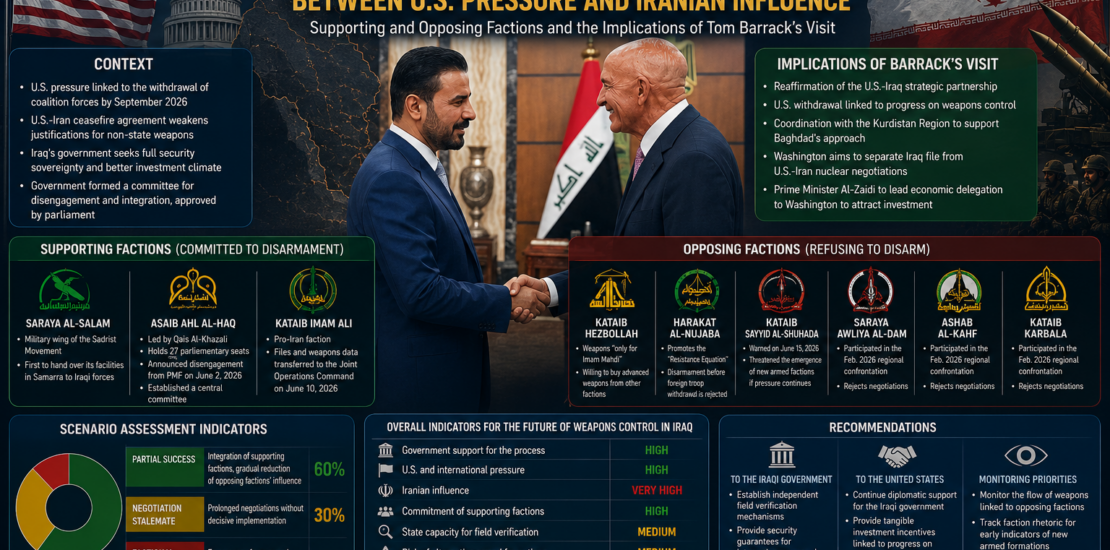
Iraq is entering a critical phase in its state-building process as Prime Minister Ali Al-Zaidi’s government seeks to place all weapons under state control and integrate armed factions into official security institutions before the end of September 2026.
This process has resulted in a clear division among armed groups: three factions have announced their commitment to the integration process, while six factions continue to reject disarmament.
The visit of U.S. Special Envoy Tom Barrack to Baghdad and Erbil on 15–16 June 2026 reinforced this process and explicitly linked it to the future of U.S.-Iraqi relations and the anticipated withdrawal of American military forces.
Executive Summary
Iraq is undergoing one of its most sensitive political and security transitions since the defeat of ISIS, as the government attempts to implement a comprehensive weapons control framework and redefine the relationship between armed factions and state institutions.
Recent developments reveal a clear split within Iraq’s armed landscape. Several factions have expressed willingness to join the integration process, while others continue to reject disarmament and link their position to regional security considerations and the presence of foreign military forces.
The Iranian factor remains one of the most influential variables shaping the future of this file, given the organizational, military, and political ties between Tehran and several armed factions operating in Iraq.
The visit of U.S. Special Envoy Tom Barrack to Baghdad and Erbil further underscored Washington’s strategic interest in this issue and reinforced the linkage between progress on weapons control and the future of security and economic cooperation between Iraq and the United States.
This paper concludes that Iraq is likely to achieve partial progress in the weapons control process in the near term. However, a comprehensive resolution remains constrained by the structure of the opposing factions, Iranian influence, and the broader political and security environment.
First: General Context — The Weapons Control Process
Since the formation of Al-Zaidi’s government in May 2026, the issue of weapons control has become a central pillar of Iraq’s security agenda.
The process is driven by three main factors:
- U.S. pressure linked to the withdrawal of coalition forces from Iraqi bases by the end of September 2026.
- The U.S.-Iran ceasefire agreement, which weakened traditional justifications for maintaining weapons outside state control.
- The government’s desire to restore full security sovereignty and improve Iraq’s investment environment.
The government established a specialized committee for disengagement and integration under the supervision of the Commander-in-Chief of the Armed Forces, with parliamentary approval.
This initiative represents a major test of the Iraqi state’s ability to assert authority over a complex network of armed actors influenced by both Iranian connections and domestic political calculations.
Second: Factions Supporting Disarmament
Three factions have publicly committed to the weapons control process:
Saraya Al-Salam
The military wing of the Sadrist Movement was the first faction to hand over its facilities in Samarra to Iraqi security forces in Salah al-Din Province during an official ceremony attended by Lieutenant General Qais Al-Mohammadawi.
Asaib Ahl al-Haq
Led by Qais Al-Khazali, the movement holds 27 parliamentary seats, reflecting its increasing focus on political influence. It announced its disengagement from the Popular Mobilization Forces on 2 June 2026 and established a central committee to oversee the transition process.
Kataib Imam Ali
On 10 June 2026, the Joint Operations Command received complete records relating to personnel, weapons, and equipment belonging to the group, marking one of the first practical implementation steps of the integration process.
Third: Factions Opposing Disarmament
Six factions have openly rejected the process.
Kataib Hezbollah Iraq
The group declared that its weapons would “only be handed over to Imam Mahdi,” reflecting an ideological position resistant to negotiation. Senior official Abu Mujahid Al-Assaf also expressed willingness to acquire advanced weapons from other factions, including drones, ballistic missiles, and anti-armor systems.
Harakat Al-Nujaba
The movement continues to promote the concept of the “Resistance Equation,” arguing that disarmament before the withdrawal of foreign forces would undermine a key deterrence capability.
Kataib Sayyid al-Shuhada
On 15 June 2026, the group warned that new armed organizations could emerge if pressure regarding disarmament continued.
Saraya Awliya al-Dam, Ashab al-Kahf, and Kataib Karbala
These factions reportedly participated in the Iranian-American-Israeli confrontation that erupted in February 2026 and continue to reject negotiations regarding their weapons while foreign military forces remain present.
Information and documents reviewed by Syria Monitor indicate ongoing indications of weapons flows linked to some of the opposing factions. The available information also suggests continued weapons smuggling activities and the regular movement of military equipment into Iraq, increasing the significance of Tehran’s position in determining the future of the disarmament process.
Observers also noted that Iranian Ambassador Mohammad Kazem Al-Sadeq met with the Iraqi Prime Minister only two hours after the latter’s meeting with Tom Barrack, highlighting the intensity of competition over influence within Iraq.
Comparative Overview of Faction Positions
| Position | Faction | Affiliation | Notes |
|---|---|---|---|
| Supporting | Saraya Al-Salam | Sadrist Movement | First to hand over facilities |
| Supporting | Asaib Ahl al-Haq | Political faction with 27 seats | Central committee established |
| Supporting | Kataib Imam Ali | Pro-Iran faction | Files transferred on 10 June |
| Opposing | Kataib Hezbollah | Ideological alignment | Weapons linked to religious doctrine |
| Opposing | Harakat Al-Nujaba | Pro-Iran faction | Resistance narrative |
| Opposing | Kataib Sayyid al-Shuhada | Pro-Iran faction | Threatened formation of new groups |
| Opposing | Saraya Awliya al-Dam | Armed faction | Participated in regional conflict |
| Opposing | Ashab Al-Kahf | Armed faction | Participated in regional conflict |
| Opposing | Kataib Karbala | Armed faction | Opposes disarmament |
Fourth: Tom Barrack’s Visit — Context and Implications
Tom Barrack, appointed U.S. Special Envoy for Iraq and Syria on 1 June 2026, visited Baghdad on 15 June and Erbil on 16 June.
Key outcomes included:
- Reaffirmation of the long-term strategic partnership between Iraq and the United States.
- Linking progress in weapons control to future security and investment cooperation.
- Emphasizing that completion of the U.S. military withdrawal by September 2026 depends on measurable progress regarding armed factions.
- Strengthening regional support for the Iraqi government’s approach through consultations in Erbil.
- Efforts to separate the Iraqi file from broader U.S.-Iran nuclear negotiations.
Prime Minister Al-Zaidi also announced plans to lead an economic delegation to Washington to attract investment in energy and infrastructure projects, supported by proposals for a multi-billion-dollar investment fund.
Scenario Assessment Indicators
| Scenario | Description | Assessment |
|---|---|---|
| Partial Success | Integration of supporting factions while gradually reducing the influence of opposing factions | 60% |
| Negotiation Stalemate | Continued negotiations without decisive implementation | 30% |
| Factional Escalation | Emergence of new armed structures and increased resistance | 10% |
Fifth: Challenges and Future Scenarios
Overall Indicators
| Factor | Impact Level |
|---|---|
| Government Support | High |
| U.S. and International Pressure | High |
| Iranian Position | Very High |
| Commitment of Supporting Factions | High |
| State Verification Capacity | Medium |
| Risk of Alternative Armed Structures | Medium |
| Probability of Full Success in 2026 | Low to Moderate |
Structural Challenges
- Lack of independent verification mechanisms.
- The issue of Iranian-owned or Iranian-linked weapons systems.
- Risks of weapons transfers to successor organizations.
- Security concerns regarding storage facilities for advanced weapons.
Syria Monitor Assessment
Syria Monitor assesses the weapons control process as the most significant security and political test facing Iraq since the defeat of ISIS.
While progress has been achieved through the participation of several factions, current indicators do not support expectations of a complete resolution in the near term.
The available evidence suggests that several opposing factions continue to view their weapons as part of a broader regional deterrence framework extending beyond Iraq’s borders.
Accordingly, gradual progress toward integration and restructuring appears more likely than the complete elimination of armed actors operating outside state control during 2026.
Sixth: Recommendations
To the Iraqi Government
- Establish independent field verification mechanisms before announcing completion of any disarmament phase.
- Provide clear security guarantees for personnel joining the integration process.
- Differentiate between negotiable factions and those ideologically aligned with external actors.
To the United States
- Continue diplomatic support for the Iraqi government.
- Provide tangible investment incentives linked to progress in weapons control.
Monitoring Priorities
- Monitor the movement of weapons associated with opposing factions.
- Track faction rhetoric for indications of new armed formations.
Conclusion
The weapons control process represents an existential test for the future identity of the Iraqi state in the post-PMF era.
Despite the momentum generated by Tom Barrack’s visit and the strategic shift demonstrated by several major factions, comprehensive success remains dependent on two key variables: Tehran’s willingness not to obstruct the process and the Iraqi government’s ability to transform political commitments into verifiable field implementation.
The coming months leading to September 2026 are likely to be decisive.
Issued by:
Syria Monitor Strategic Research Center
Policy Papers Division
June 2026