
Weekly Monitoring of ISIS Activity in Iraq Reporting Period: 22–28 June 2026
- June 28, 2026
- Posted by: Syria Monitor
- Category: Iraq
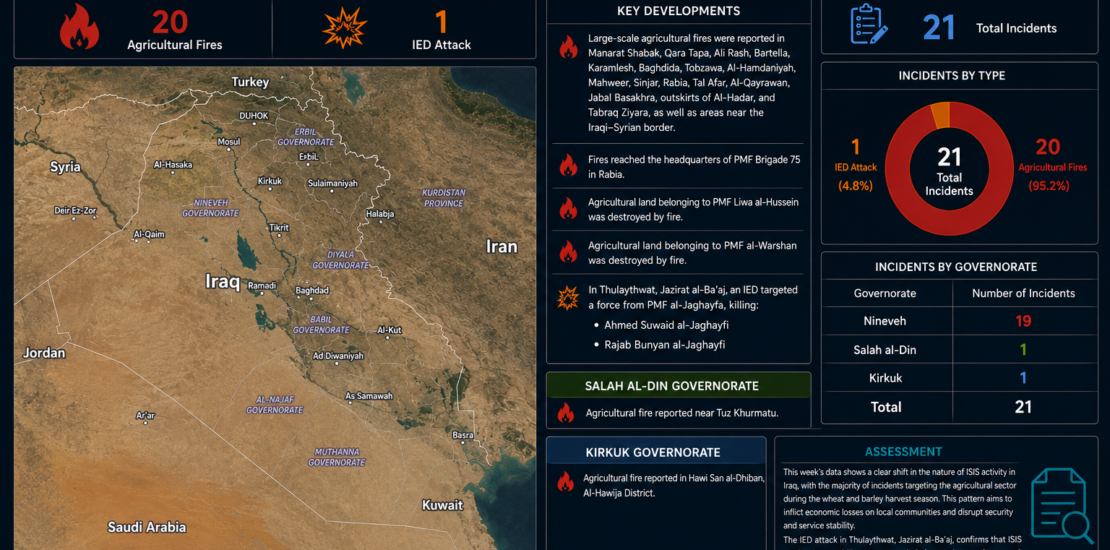
The Syria Monitor Strategic Research Center documented 21 ISIS-related security incidents across Iraq during the reporting period of 22–28 June 2026. Activity was overwhelmingly concentrated in Nineveh Governorate, consisting primarily of widespread agricultural fires, one improvised explosive device (IED) attack against a security force, and indicators of continued ISIS activity in desert areas.
Agricultural fires represented the dominant operational pattern throughout the week, affecting large areas across the Nineveh Plains, Rabia, Sinjar, Tal Afar, and Al-Hadar, damaging both civilian farmland and agricultural property belonging to Popular Mobilization Forces (PMF) formations.
Key Developments
Nineveh Governorate
Nineveh recorded the highest level of ISIS-related activity during the reporting period, including:
- Large-scale agricultural fires in Manarat Shabak, Qara Tapa, Ali Rash, Bartella, Karamlesh, Baghdida, Tobzawa, Al-Hamdaniyah, Mahweer, Sinjar, Rabia, Tal Afar, Al-Qayrawan, Jabal Basakhra, Al-Hadar, and Tabraq Ziyara, in addition to areas near the Iraqi–Syrian border.
- Several fires spread toward security-related facilities, including:
- Fire reaching the headquarters of the 75th PMF Brigade in Rabia.
- Agricultural land belonging to PMF Liwa al-Hussein destroyed by fire.
- Agricultural land belonging to PMF al-Warshan affected by fire.
- In Thulaythwat, Jazirat al-Ba’aj, an IED targeted members of PMF al-Jaghayfa, killing:
- Ahmed Suwaid al-Jaghayfi.
- Rajab Bunyan al-Jaghayfi.
Salah al-Din Governorate
- Agricultural fire reported near Tuz Khurmatu.
Kirkuk Governorate
- Agricultural fire reported in Hawi San al-Dhiban, Al-Hawija District.
Statistics
- Total incidents: 21
- Agricultural fires: 20
- IED attacks: 1
Affected Governorates
- Nineveh
- Salah al-Din
- Kirkuk
Assessment
This week’s data indicate a clear shift in ISIS operational activity in Iraq, with the overwhelming majority of incidents involving targeted agricultural fires during the wheat and barley harvest season. This pattern appears intended to inflict economic damage, undermine local stability, and strain security resources.
The IED attack in Thulaythwat, Jazirat al-Ba’aj, meanwhile, demonstrates that ISIS retains the capability to conduct lethal attacks against security forces in western Nineveh’s desert environment despite the reduced tempo of conventional attacks.
The concentration of incidents across a continuous geographical corridor extending from the Nineveh Plains through Sinjar, Rabia, and Tal Afar further highlights these areas as the primary focus of ISIS activity during the reporting period.