
Weekly Report on ISIS Attacks in Africa
- July 19, 2026
- Posted by: Syria Monitor
- Categories: Africa, Maps
No Comments
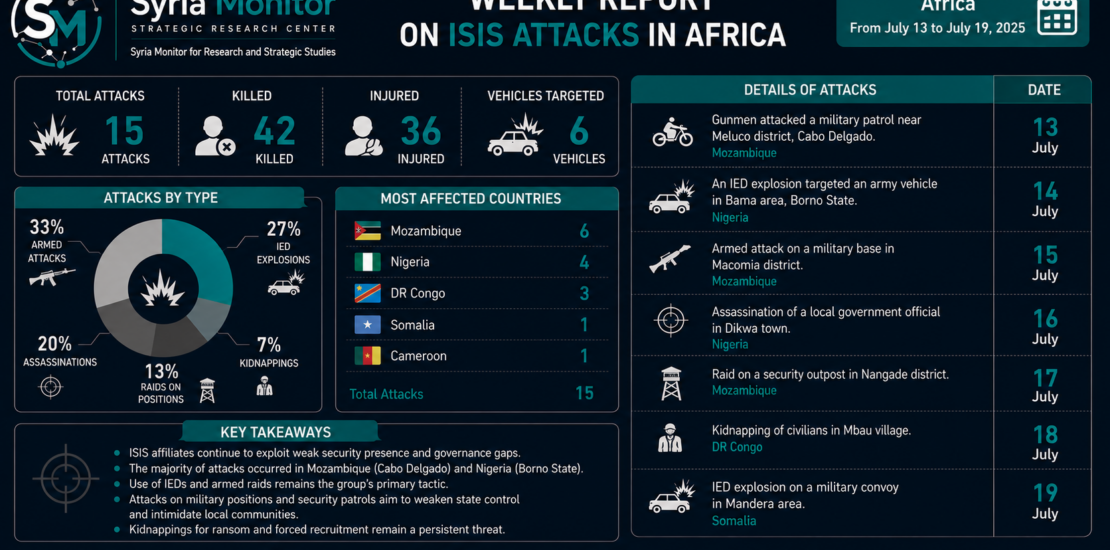
Reporting Period: 13–19 July 2026
ISIS affiliates remained highly active across several African theaters during the period 13–19 July 2026, conducting a series of attacks against military forces, security personnel, and civilian targets. Operations were concentrated primarily in Nigeria, the Democratic Republic of the Congo (DRC), and Mozambique, reflecting the organization’s continued operational resilience and geographic expansion across the continent.
The attacks included armed assaults, improvised explosive device (IED) attacks, raids on military positions, targeted killings, and kidnappings, demonstrating the group’s ability to sustain pressure on state security forces while exploiting weak governance and difficult terrain.
Key Indicators
-
Total attacks: 15
-
Killed: 42
-
Injured: 36
-
Vehicles targeted: 6
Geographic Distribution
The highest level of activity was recorded in Mozambique, followed by Nigeria and the Democratic Republic of the Congo (DRC), with additional incidents reported in Somalia and Cameroon.
The concentration of attacks in these countries highlights ISIS’s continued focus on fragile security environments, border regions, and remote rural areas where state presence remains limited.
Operational Patterns
During the reporting period, ISIS affiliates employed a range of tactics, including:
-
Armed assaults against military bases and security patrols.
-
Improvised explosive device (IED) attacks targeting military convoys and vehicles.
-
Targeted assassinations of security personnel and local officials.
-
Raids on military outposts and checkpoints.
-
Kidnappings of civilians for intimidation, ransom, and recruitment purposes.
Assessment
The week’s activity demonstrates that ISIS branches in Africa continue to represent the organization’s most active operational theaters. Their ability to conduct coordinated attacks across multiple countries underscores resilient command structures, sustained recruitment, and access to local support networks.
The continued emphasis on targeting military positions, security patrols, and isolated communities indicates a strategy aimed at weakening state authority, expanding influence in contested regions, and maintaining operational momentum despite ongoing counterterrorism efforts.
how can we help you?
Contact us at the Consulting WP office nearest to you or submit a business inquiry online.