
Weekly Report on ISIS Attacks in Iraq
- July 19, 2026
- Posted by: Syria Monitor
- Categories: Iraq, Maps
No Comments
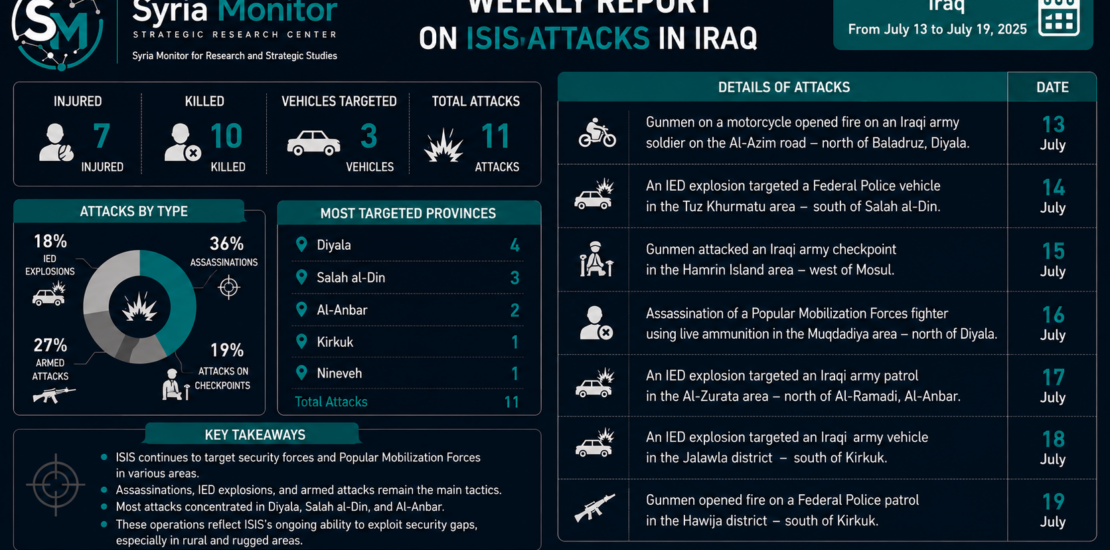
Reporting Period: 13–19 July 2026
ISIS maintained a steady operational tempo across Iraq during the period 13–19 July 2026, carrying out a series of attacks targeting Iraqi Army units, Federal Police, and Popular Mobilization Forces (PMF). The group’s activities relied primarily on targeted assassinations, improvised explosive devices (IEDs), and attacks against checkpoints and security patrols.
The highest concentration of attacks was recorded in Diyala, Salah al-Din, and Al-Anbar, with additional incidents reported in Kirkuk and Nineveh. This distribution reflects ISIS’s continued exploitation of rugged terrain, rural belts, and security gaps between provincial boundaries.
Key Indicators
-
Total attacks: 11
-
Killed: 10
-
Injured: 7
-
Vehicles targeted: 3
Geographic Distribution
Diyala recorded the highest number of attacks with four incidents, followed by Salah al-Din with three, Al-Anbar with two, while Kirkuk and Nineveh each recorded one attack.
This pattern highlights ISIS’s continued focus on operating in remote rural areas, particularly along the Diyala–Salah al-Din belt, the western deserts of Al-Anbar, and the mountainous and sparsely populated areas surrounding Kirkuk and Nineveh.
Operational Patterns
During the reporting period, ISIS relied on a combination of tactics, including:
-
Targeted assassinations carried out by motorcycle-borne gunmen.
-
IED attacks against military vehicles and security patrols.
-
Armed assaults on checkpoints and isolated military positions.
-
Rapid hit-and-run operations followed by withdrawal into remote terrain.
Assessment
This week’s activity demonstrates that ISIS continues to pursue a strategy of low-intensity attrition warfare rather than attempting to seize or hold territory. The organization remains focused on inflicting sustained losses on Iraqi security forces through small-scale, dispersed operations.
The attacks further indicate that ISIS retains the ability to move across provincial boundaries, exploit difficult terrain, and maintain local support networks capable of gathering intelligence, monitoring security force movements, preparing IEDs, and conducting coordinated attacks despite ongoing counterterrorism operations.
how can we help you?
Contact us at the Consulting WP office nearest to you or submit a business inquiry online.