
Why Do ISIS Leaders in Central Africa Survive Airstrikes?
- June 11, 2026
- Posted by: Syria Monitor
- Categories: Africa, SITUATION ASSESSMENT
Syria Monitor Strategic Research Center
For years, eastern Democratic Republic of the Congo has witnessed continuous military operations targeting the Allied Democratic Forces (ADF), a group that pledged allegiance to the Islamic State and later became part of what is known as the Islamic State Central Africa Province (ISCAP).
Despite dozens of military operations and airstrikes conducted by Ugandan and Congolese forces in recent years, the organization’s senior leadership has remained capable of surviving, reorganizing its ranks, and continuing to direct armed operations across the region.
This phenomenon raises growing questions regarding the factors that make targeting the group’s senior leadership such a complex mission despite the military and technological superiority possessed by government forces.
Who Is Musa Baluku?
Musa Baluku is currently regarded as the most prominent figure within ADF/ISCAP and is widely considered the organization’s de facto leader as well as one of the most influential Islamic State leaders on the African continent.
Numerous reports indicate that Baluku oversees the group’s military and logistical activities in eastern Congo. His name has also been linked to multiple operations targeting government forces and civilians over the past several years.
Following the restructuring of several Islamic State provinces in 2025, Musa Baluku emerged as one of the most significant ISIS figures in Central Africa and among the most influential operational leaders in the region.
Why Is It Difficult to Target the Leadership?
Although Ugandan and Congolese forces repeatedly obtain intelligence regarding the organization’s locations, several factors make precision strikes against senior leaders extremely difficult.
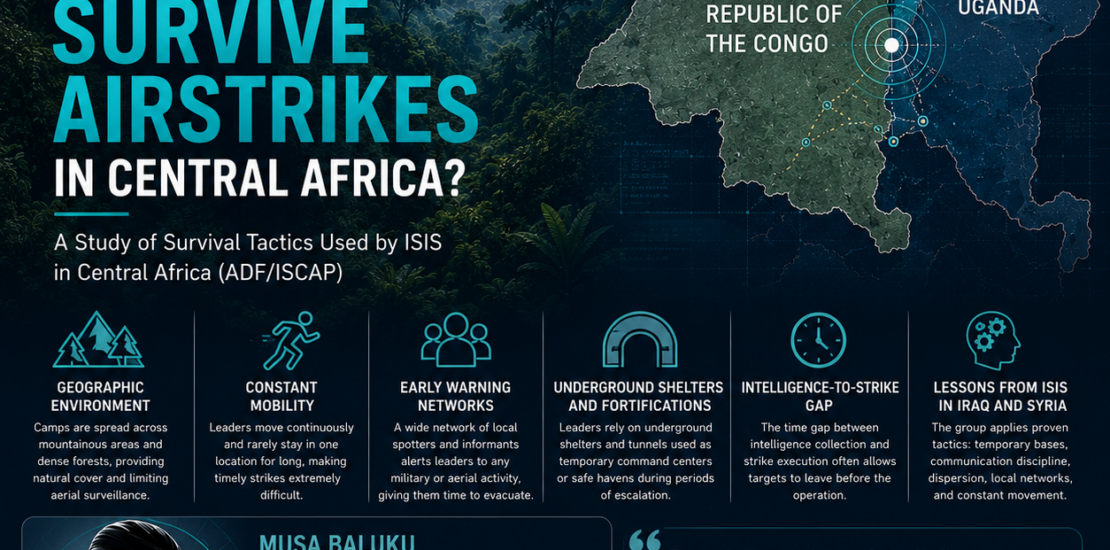
Geographic Environment
The group’s camps are dispersed throughout mountainous terrain and dense forests in eastern Congo, where the complex landscape provides natural concealment that complicates continuous surveillance operations.
This environment limits the effectiveness of drones and aerial reconnaissance while granting militants considerable freedom of movement between different locations.
Constant Leadership Mobility
The organization’s leadership relies on continuous movement and avoids remaining at any single location for extended periods.
Field reporting suggests that some headquarters are used for only a few hours or days before leaders relocate elsewhere, reducing the chances of successful airstrikes even when relatively accurate intelligence is available.
Early Warning Networks
One of the primary reasons behind the failure of many strikes is the organization’s extensive network of local observers and informants positioned around camps and operational areas.
These networks alert commanders to military movements or suspicious aerial activity, providing sufficient time to evacuate positions before strikes occur.
Fortifications and Underground Shelters
Available field information indicates that some leaders rely on underground shelters and concealed living quarters constructed beneath forested areas.
These facilities serve as temporary command centers and safe havens during periods of military escalation, significantly reducing the effectiveness of conventional airstrikes.
The Intelligence-to-Strike Gap
Many operations against the organization suffer from a well-known intelligence challenge commonly referred to as the Intelligence-to-Strike Gap.
This refers to the time interval between collecting intelligence and executing a military strike.
In many cases, the intelligence itself is accurate, but the target departs the location hours or even days before the operation is conducted, resulting in mission failure despite the reliability of the original information.
How Has the Organization Benefited from ISIS Experience in Iraq and Syria?
Current operational patterns within ISIS in Central Africa reveal strong similarities to tactics previously employed by the organization in Iraq and Syria during years of conflict.
These methods include:
- Establishing temporary command locations.
- Limiting the use of exposed communication systems.
- Dispersing leadership across multiple sites.
- Utilizing underground shelters and tunnel networks.
- Relying on local human early-warning systems.
- Maintaining constant mobility and avoiding large gatherings.
These tactics previously proved effective in prolonging the survival of numerous ISIS field commanders throughout the Middle East.
Future Assessment
Current indicators suggest that the principal challenge facing Ugandan and Congolese forces is not a lack of military capability, but rather the ability to maintain persistent surveillance and execute strikes within extremely short timeframes.
ISIS in Central Africa is therefore likely to preserve part of its leadership structure in the near term as long as it remains capable of exploiting complex terrain, early-warning networks, and dispersed shelter systems across its areas of operation.
Conversely, the success of future campaigns aimed at eliminating the organization’s leadership will largely depend on improving persistent surveillance capabilities, accelerating the conversion of intelligence into immediate operational action, and reducing opportunities for information leaks within the environments where the group operates.
Prepared by: Syria Monitor Strategic Research Center